

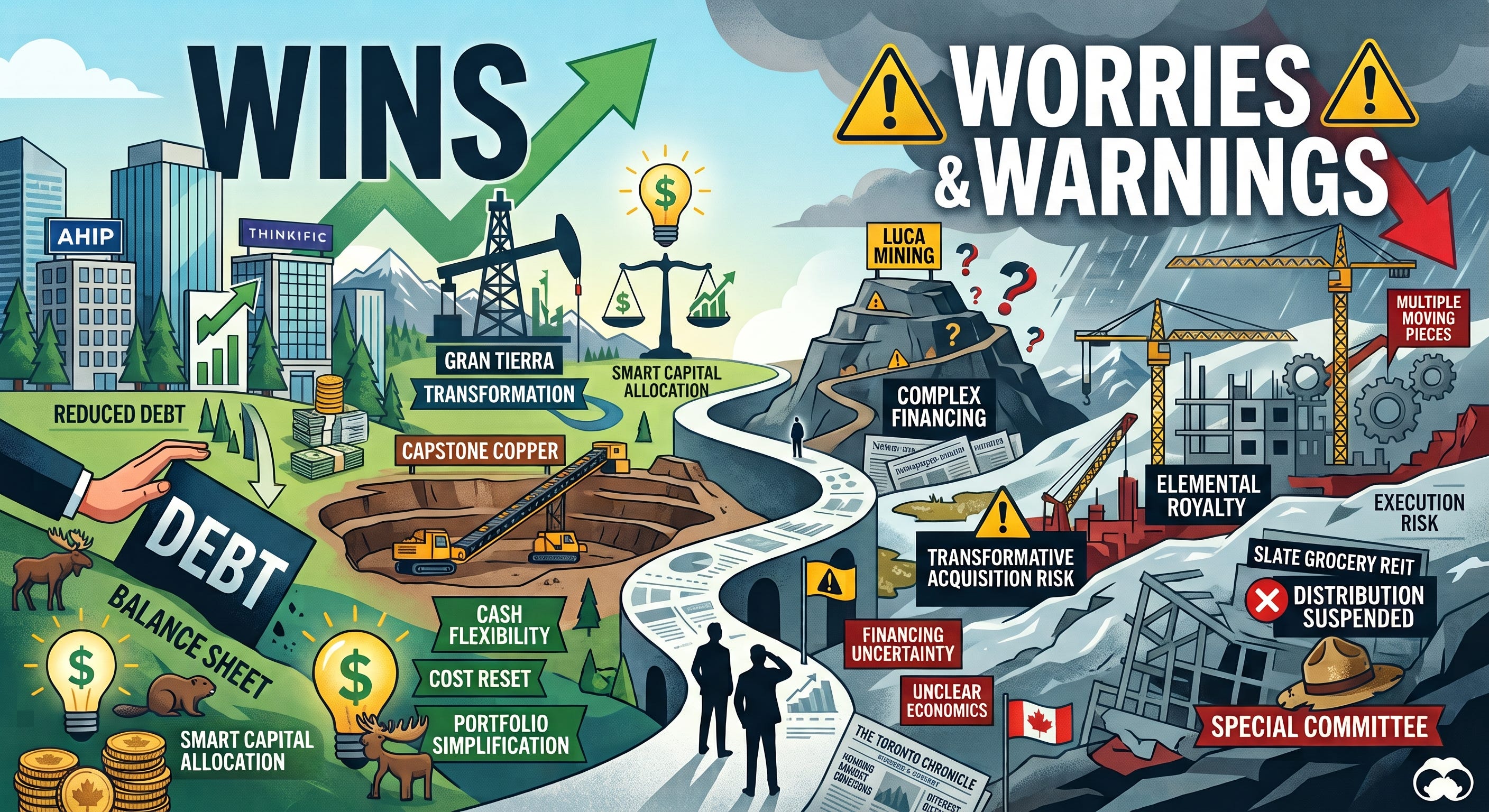
There was no shortage of news this week.
Buybacks. Asset sales. Acquisitions. CEO changes. Strategic reviews. Restructurings. A company trying to get out of CCAA. Another cutting nearly 100 employees. One selling essentially its entire South American business. Another spending hundreds of millions to buy a mine.
The problem with reading a news feed is that everything is presented as newsworthy.
It isn’t.
A company authorizing a buyback doesn’t mean it will actually buy the shares.
A CEO appointment doesn’t necessarily change anything.
And an acquisition can create enormous value or simply transfer value from existing shareholders to whoever sold the asset.
So rather than repeat the releases, I went through them looking for something more useful:
What actually improved shareholder economics?
What deserves attention but still needs proof?
And what should make investors stop and look twice?
Welcome to:
WINS. WORRIES. WARNINGS.
WINS
These are the developments where something tangible appears to have improved: balance-sheet risk came down, capital was returned intelligently, an asset was monetized, costs were materially reset, or a transaction moved meaningfully closer to completion.
American Hotel Income Properties: selling assets to deal with the balance sheet
This is exactly the kind of divestiture I pay attention to.
American Hotel Income Properties announced agreements to sell six hotels for approximately US$95 million of gross proceeds, with cash and net proceeds intended in part to repay US$25 million of Series C preferred shares and US$49.7 million of convertible debentures due December 31, 2026.
Forget the word divestiture.
The important part is what the money is being used for.
AHIP has a near-term capital-structure problem. Selling hotels and directing proceeds toward securities sitting ahead of common unitholders potentially reduces that pressure.
That’s much more meaningful than selling assets simply to manufacture an accounting gain.
Win: converting real estate into liquidity and attacking near-term obligations.
What matters next is what remains after the transactions close: remaining debt, interest expense, asset-level cash generation and the value attributable to common unitholders after the balance sheet has been reshaped.
Thinkific: 96 jobs disappear, but the economics could change dramatically
Thinkific announced one of the more consequential operating changes on the list.
The company eliminated 96 positions and expects approximately US$19 million of annualized cost savings, against roughly US$5 million of restructuring charges.
More importantly, Thinkific now targets a 25%+ free-cash-flow margin beginning in fiscal 2027.
And this isn’t happening alongside an immediate revenue warning. Thinkific simultaneously said Q3 revenue should land at the high end of its US$18.6–US$18.9 million guidance and increased adjusted EBITDA margin guidance from 2%–5% to 7%–10%.
That’s interesting.
The obvious question is whether Thinkific has discovered genuine operating leverage or is simply cutting its way toward a margin target that eventually compromises growth.
But when a company can remove approximately $19 million of annualized costs while maintaining near-term revenue expectations, shareholders should pay attention.
Win: a potentially material reset in the cost structure.
Now they have to prove the savings don’t come at the expense of the business they’re trying to grow.
Gran Tierra: this is much bigger than a routine asset sale
Gran Tierra’s proposed sale of its Colombian and Ecuadorian operations for US$1.33 billion deserves more attention than the September proxy release alone suggests.
The transaction includes the purchaser assuming substantial liabilities. Gran Tierra previously estimated approximately US$315 million of net cash proceeds, including about US$250 million at closing, with the remaining US$65 million payable later. The continuing company would retain Canada and Azerbaijan.
The latest development is procedural but important: the definitive proxy is filed, the shareholder meeting is scheduled for October 9, and required consent relating to the 2031 secured notes has progressed.
This is effectively a corporate transformation.
Win: a heavily leveraged international producer could emerge from the transaction with a radically different balance sheet and asset base.
But shareholders still have to approve it, regulatory conditions remain, and the economics of what remains matter more than the headline US$1.33 billion.
Capstone Copper: selling Cozamin and recycling the capital
Capstone Copper agreed to sell Cozamin for up to US$385 million.
The structure is:
US$275 million cash at closing, US$15 million of Luca shares, US$35 million deferred, and up to US$60 million contingent on copper prices.
Capstone is using the transaction to strengthen its balance sheet and redirect capital toward larger growth projects.
That’s a much cleaner capital-allocation story than simply collecting assets.
Not every dollar of the advertised US$385 million is guaranteed—the copper-linked component matters—but monetizing a mature asset while concentrating capital elsewhere can make economic sense.
Win: portfolio simplification plus additional financial flexibility.
Coveo: this buyback is more interesting than the average NCIB
Most buyback announcements belong in the maybe pile.
Coveo is different.
Coveo agreed to repurchase and cancel 2,615,859 shares from a subsidiary of Qatar Investment Authority for approximately C$9.81 million, or C$3.75 per share.
That price was a 10.5% discount to Coveo’s September 22 TSX closing price.
That’s materially different from merely receiving permission to buy stock someday.
The shares are actually being retired, and they’re being purchased below the prevailing market price.
Win: tangible per-share capital allocation rather than a buyback press release.
Bold Ventures: the headline missed half the story
Barksdale’s release wasn’t merely a management shuffle.
Barksdale Resources announced a proposed C$14 million private placement at C$0.18 per unit, with each unit containing a share and half a warrant exercisable at C$0.30 for two years.
The financing accompanies a major management and board reset and follows exploration results at Sunnyside.
For an exploration company, C$14 million is meaningful capital.
So I’m putting the financing itself in Wins, while keeping the dilution in mind.
This is exactly why these classifications shouldn’t be interpreted as “stock good” or “stock bad.”
Win: meaningful funding for the next stage of exploration.
Catch: approximately 77.8 million units at the maximum raise is a lot of new paper, plus warrants.
Both things can be true.
Bold Ventures: small company, meaningful monetization
Bold signed a binding LOI covering 38 Burchell claims in exchange for C$500,000 cash, 150,000 Gold X2 shares valued at approximately C$1.25 million at the referenced market price, plus a 2% NSR on specified critical minerals excluding copper.
Against the roughly C$4.5 million market capitalization in the screen supplied for this review, that is not immaterial.
This is the kind of microcap transaction that deserves context against the company’s entire valuation.
Win: monetizing part of an asset package while retaining exposure through equity and a royalty.
Kinross: a Win sitting beside an operational Worry
Kinross Gold increased its 2026 shareholder-return target from 40% to 50% of free cash flow.
That’s meaningful.
But don’t read the capital-return headline without the operational update.
Kinross now expects 2026 and 2027 attributable production to come in 2%–3% below the low end of previous guidance, at approximately 1.84–1.86 million gold-equivalent ounces annually, while 2026 AISC is expected at approximately US$1,850–US$1,900/oz.
So:
Win: more cash being returned to shareholders.
Worry: lower production expectations and operational issues at La Coipa and Round Mountain.
That’s a far more useful description than simply calling the release positive.
Other capital-return Wins — with one important caveat
Air Canada expects to retire approximately 27.6 million shares at C$29, roughly 9.8% of shares outstanding, through its C$800 million substantial issuer bid.
HLS Therapeutics increased its permitted NCIB to 1,872,685 shares, approximately 10% of public float.
MDA Space can repurchase up to 8,106,539 shares, approximately 5% of outstanding shares.
Stingray renewed its NCIB for up to roughly 10% of public float.
Dream Unlimited and Toromont also announced substantial NCIB capacity.
National Bank announced plans for another buyback program, subject to approvals.
But here’s the distinction:
Air Canada’s tender actually specifies the shares expected to disappear. An NCIB authorization merely gives management permission to buy.
Permission isn’t execution.
I wouldn’t give every NCIB the same weight.
WORRIES
These aren’t necessarily negative developments.
They’re situations where the headline sounds cleaner than the underlying economics—or where something important still has to be proven.
Luca Mining just became a much bigger story
Luca Mining is buying Cozamin.
The price is US$290 million upfront plus as much as US$95 million of deferred and contingent consideration. Cozamin has been operating for roughly 20 years and is cash-generating.
That’s the attractive part.
The other side is financing.
The acquisition is supported by a roughly US$300 million financing package involving credit, equity and streaming components.
For a company whose market capitalization in the supplied screen was approximately C$216 million, this isn’t a bolt-on.
It’s transformative.
That means the right question isn’t:
“Is Cozamin a good mine?”
It’s:
What do Luca shareholders own per share after the financing, streaming commitments, debt and acquisition consideration are layered together?
Worry: potentially transformative asset acquisition accompanied by potentially transformative financing.
This one deserves a full post-transaction capital-structure review.
Elemental Royalty: bigger, immediately — but at a price
Elemental Royalty agreed to acquire five royalty and streaming assets from Orion for US$290 million, consisting of US$200 million cash and US$90 million in equity.
Management says the portfolio should be immediately accretive to NAV per share and materially accretive to revenue per share.
That’s the management case.
The investor question is whether the financing structure and price paid produce the promised per-share accretion once everything closes.
At the same time, Elemental is divesting another business and changing CEOs.
That’s a lot happening at once.
Worry: multiple major moving pieces make execution—not the acquisition headline—the important variable.
Slate Grocery REIT: suspending the distribution changes the conversation
Slate Grocery REIT suspended its monthly cash distribution while its special committee continues a strategic review.
Management specifically said the decision wasn’t prompted by a change in the underlying fundamentals or long-term outlook of the portfolio.
Fair enough.
But distributions are a central part of the REIT investment proposition.
Slate had been paying US$0.072 per unit monthly through August.
Suspending that payment to preserve financial and strategic flexibility tells you something important regardless of management’s explanation:
cash is currently considered more valuable inside the REIT than being distributed to unitholders.
That may prove smart.
It may facilitate a transaction.
But until the strategic review produces something concrete:
Worry: income disappears today in exchange for optionality tomorrow.
Cineplex: strategic review is interesting. A sale is not a fact.
Cineplex appointed Bill Walker CEO and simultaneously launched a strategic review.
The board explicitly said alternatives may include a potential sale of the company and retained Goldman Sachs and TD Securities as financial advisors.
That’s enough to make this interesting.
It’s not enough to assume a takeover.
Cineplex had also just reported record Q2 2026 revenue and subsequently its highest monthly box office ever in August, according to its corporate news archive.
So the setup is unusual:
improving operating momentum, a CEO transition and a formal strategic review all occurring together.
Worry—or opportunity to watch: the market will inevitably speculate about a sale, but no transaction exists yet.
Treat the process as optionality, not consideration receivable.
WSP walking away may actually demonstrate discipline
WSP Global abandoned its proposed Arcadis acquisition after failing to establish a negotiated path forward.
Arcadis says its boards rejected WSP’s approaches as undervaluing the business; WSP says it remained convinced of the strategic rationale but wouldn’t proceed without constructive engagement.
I’m putting this in Worries rather than Wins because the strategic opportunity disappeared.
But there is another interpretation:
not doing a deal can be excellent capital allocation when the alternative is overpaying.
No trophy is awarded for completing an acquisition.
Stamper: less cash out, much more equity out
Stamper Oil & Gas renegotiated deferred consideration on its Namibia acquisition.
Remaining cash obligations fell from US$1.25 million to US$500,000.
Good.
But the equity component increased from 8,561,644 shares to 16,500,000 shares.
That’s precisely the kind of release where “reduced cash consideration” can sound better than the complete economics.
For a company with a supplied market capitalization of only about C$5.5 million, the share issuance deserves attention.
Worry: cash pressure improves by transferring more of the consideration into equity.
Existing shareholders need to measure the dilution, not just celebrate the lower cash payment.
WARNINGS
This is where the language gets more serious.
A Warning doesn’t mean a company is doomed.
It means the event touches something fundamental enough—solvency, disclosure, financing access, capital structure or governance—that I wouldn’t casually move past it.
Simply Solventless: progress inside CCAA is still CCAA
Simply Solventless reported several genuinely positive restructuring developments.
The company says C$1 million of government rebates have been approved, it settled C$600,000 of vendor take-back debt for C$100,000, its management cease trade order was revoked, and it expects to exit restructuring between late October and late November.
Those are real improvements.
But context beats headlines.
The company remains in CCAA restructuring, the stay has been extended to November 30, and it is pursuing financing that includes up to 20 million units at C$0.05, alongside debt settlements involving equity.
That’s not a normal operating situation.
Warning: restructuring progress is not the same thing as a repaired capital structure.
For existing shareholders, the decisive question is what the equity looks like after restructuring, financing and debt conversion.
Lancaster Resources: failed financing is the important sentence
Lancaster announced a strategic review and moved to semi-annual reporting.
Neither is the main story.
The important part is that the company moved toward strategic alternatives after failing to complete its previous financing on acceptable terms.
It is considering financing, partnerships, asset transactions and other alternatives while preserving capital.
That is a classic microcap pressure point.
When a pre-revenue company cannot raise money on terms it considers acceptable, the question becomes:
How long can it wait before the market dictates the terms anyway?
Warning: financing access.
Everything else is secondary until that gets resolved.
Planet Ventures: the CEO resignation isn’t happening in isolation
Planet Ventures announced that CEO Etienne Moshevich resigned effective September 24, with the board still considering a replacement.
A resignation alone wouldn’t necessarily make the Warning bucket.
But the company also completed a five-for-one share consolidation effective September 18—less than a week earlier.
That combination deserves attention.
It doesn’t prove anything improper.
It does mean shareholders should understand the company’s current capital structure, investment portfolio, liquidity, leadership plan and financing requirements before treating this as a routine executive transition.
Warning: leadership uncertainty immediately following a capital-structure change.
Stamper gets a second flag: disclosure
Stamper also issued a separate release at the request of the British Columbia Securities Commission concerning disclosure around its 2025 BISP acquisition and amended interim financial statements.
That doesn’t automatically establish wrongdoing.
But regulator-requested clarification belongs on an investor’s diligence list.
Combine that with the newly renegotiated acquisition consideration and increased equity issuance, and Stamper is one of the names from this week’s screen that deserves more work, not less.
AND THEN THERE’S THE STUFF THAT IS MOSTLY “WATCH”
A number of the remaining announcements are legitimate developments but don’t yet provide enough economic information to justify a stronger conclusion.
Sernova’s upcoming presentation about its proposed Seraxis combination is a watch item, not a catalyst by itself.
Search Minerals appointed a new CEO on the same day it reported completing an upsized C$1.1 million financing. That’s more relevant than the appointment alone.
Roland Mineral’s new CEO matters only insofar as the Venezuela mineral-rights strategy ultimately produces financeable, executable assets.
Apogee Minerals, Collective Metals and Gossan Resources also announced management changes. Without a corresponding change in capital, assets or operating trajectory, I wouldn’t manufacture a thesis out of a new name on the organizational chart.
Western Metallica extended exclusivity on its Nueva Celti transaction. That’s progress, but not completion.
Kodiak Copper’s Kay Copper transaction moved forward with definitive agreements, a TSXV listing application and a C$5.37 million subscription-receipt financing, but closing remains conditional.
Terra Balcanica is increasing its ownership of Viogor to 100% by issuing 6.33 million shares. That could simplify ownership, but shareholders should measure what they’re giving up in dilution for the additional 10%.
Vecima completed the CableDiag acquisition, but without disclosed purchase economics in the material reviewed here, it’s difficult to judge whether the transaction creates value merely from the strategic description.
AI Maverick’s HEAL Access acquisition is similar: potentially important strategically, but “AI-enabled healthcare” isn’t an economic result. The acquisition terms, financing requirements and eventual revenue contribution matter.
Vireo Growth’s US$500,000 M3 Wellness acquisition is small enough relative to its supplied market capitalization that the transaction itself doesn’t materially change the thesis without evidence of what the dispensary contributes.
Chicane Capital and Left Field Capital are advancing qualifying transactions. The important work begins with the resulting capital structure and underlying businesses—not the fact that the transactions moved another procedural step forward.
Lomiko’s shareholders approved the C$0.13-per-share cash arrangement. At this point the remaining focus is closing risk and court approval rather than operating fundamentals.
Southstone’s proposed C$0.0375-per-share going-private transaction similarly turns the question into transaction mechanics and minority-shareholder consideration rather than an ordinary operating thesis.
Jamieson Wellness shareholders are approaching their vote on Kirin’s C$45.75-per-share all-cash acquisition, a transaction originally announced at an approximately 27% premium to the unaffected 20-day VWAP. Again, this is now principally an event-driven closing situation.
TC Energy’s sale of its Guadalajara-Manzanillo pipeline for approximately C$560 million/US$400 million provides additional capital for redeployment, with closing expected in the first half of 2027.
Power Corporation’s wind-project sale may similarly represent portfolio recycling, but without transaction consideration disclosed in the material reviewed here, calling it a major Win would be premature.
MDA, Dream, Toromont, HLS and Stingray all have buyback authorizations worth monitoring.
And that distinction matters.
Announcing that you can buy shares is not the same as buying them.
THE ONE WEEK, THREE-BUCKET TEST
If I had to reduce the entire screen to what actually deserves follow-up work, it would look like this:
WINS: AHIP attacking near-term obligations through asset sales; Thinkific attempting a major structural reset in free cash flow; Gran Tierra progressing a potentially transformative divestiture; Capstone monetizing Cozamin; Coveo actually retiring shares below the prior market price; Bold monetizing a meaningful portion of its asset base; and several larger companies putting real capital behind shareholder returns.
WORRIES: Luca’s acquisition financing; Elemental’s much larger post-transaction structure; Slate eliminating its distribution during a strategic review; Cineplex’s sale optionality being mistaken for an actual sale; Kinross lowering production expectations while increasing shareholder returns; and Stamper replacing cash consideration with substantially more equity.
WARNINGS: Simply Solventless remains in CCAA despite restructuring progress; Lancaster’s financing difficulties have pushed it into a strategic review; Planet Ventures lost its CEO immediately after a consolidation; and Stamper has both dilution considerations and regulator-requested disclosure work that deserve closer examination.
And that’s really the point of doing this exercise.
The market gives every press release a headline.
Investors shouldn’t give every headline equal weight.
A new CEO can mean nothing.
A 10% buyback authorization can mean nothing if no shares are purchased.
A “reduced acquisition price” can actually mean more dilution.
A distribution suspension can be intelligent capital allocation while simultaneously telling you that financial flexibility has become more valuable than paying shareholders.
And sometimes the most boring sentence in a release—the maturity date, the financing condition, the number of new shares, the debt being repaid—is the only sentence that actually matters.
That’s what Wins. Worries. Warnings is going to be about.
Not whether the news sounds good.
Whether it actually changes the economics.