

There are stocks that become misunderstood because the business is complicated.
Then there are stocks that become misunderstood because everyone thinks the business is simple.
I believe Bridgemarq Real Estate Services may fall into the second category.
The ticker is BRE.

The company owns and operates some of the most recognizable real estate brands in Canada, including Royal LePage, Via Capitale, Proprio Direct and Johnston & Daniel.
So the immediate conclusion seems obvious.
Canadian housing is weak. Real estate transactions are down. Therefore Bridgemarq must simply be another leveraged bet on Canadian housing.
I think that interpretation misses what is actually underneath the company.
And the events of the past year may have made that misunderstanding considerably larger.
The Dividend Cut Changed the Shareholder Base, Not the Brands
For years Bridgemarq was largely treated as an income security.
The company paid shareholders $0.1125 every month, equivalent to $1.35 annually.
Then on July 16, 2026, Bridgemarq effectively blew up that investment proposition.
Management announced that the annualized dividend would fall from $1.35 to just $0.05 per share.
The following trading day, BRE fell from $13.20 to $6.30, a decline of more than 52 percent.
In the weeks following it dropped more all the way to $3.72
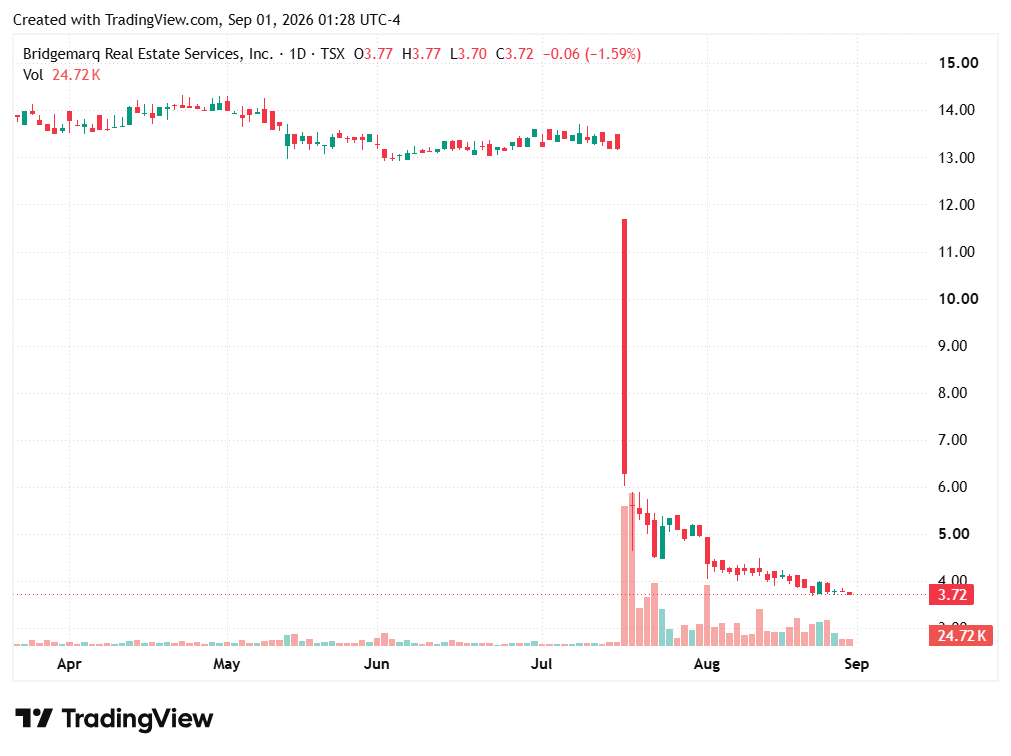
That reaction makes perfect sense if you owned Bridgemarq principally because of the dividend.
The income proposition disappeared overnight.
But something else happened at the same time.
The underlying Royal LePage franchise network did not disappear.
The Via Capitale network did not disappear.
The company did not lose its trademarks.
Thousands of agents did not suddenly leave.
Its franchise agreements did not suddenly terminate.
Instead, the market capitalization collapsed because management decided that cash previously being distributed should remain inside the company.
That distinction is the beginning of my thesis.
Bridgemarq may have undergone a forced shareholder rotation.
The investors who owned BRE because it paid them every month suddenly had very little reason to continue owning it.
But the investors who might own BRE because of its brands, franchise economics, consolidation opportunities and potential capital allocation strategy had barely begun looking at it.
That creates an unusual situation.
The company changed faster than the shareholder base could.
Brookfield Was the First Clue
The dividend reduction did not happen in isolation.
There was an important event months earlier that I think deserves much more attention.
Brookfield Business Partners is Bridgemarq’s largest economic stakeholder through approximately 6.25 million Exchangeable Units of Residential Income Fund L.P.
These units create one of the most confusing parts of Bridgemarq’s financial statements.
They are recorded as a liability.
Their fair value moves with BRE’s share price.
When BRE’s share price rises, the accounting liability increases and Bridgemarq can report an accounting loss.
When BRE’s share price falls, the liability decreases and Bridgemarq can report an accounting gain.
None of that necessarily means cash entered or left the business.
Each Exchangeable Unit can ultimately be exchanged one for one into a Bridgemarq Restricted Voting Share.
That means investors need to be very careful about reading the Exchangeable Unit liability as if it were conventional bank debt.
It is not.
And Brookfield’s economic interests are therefore much closer to those of an equity owner than a conventional lender waiting to be repaid.
This became particularly important in October 2025.
Brookfield agreed that Bridgemarq could defer distributions owing on those Exchangeable Units for twelve months.
Brookfield also established an additional credit facility to give the company greater financial flexibility.
Think about the sequence.
First, Brookfield agreed to temporarily stop taking cash out of the business.
Bridgemarq continued paying its public shareholders.
Then, in July 2026, Bridgemarq dramatically reduced the cash being distributed to those shareholders as well.
Those decisions look very different when viewed together rather than independently.
The company appears to have progressively moved from distributing capital toward retaining capital.
And management has told investors exactly what it wants to do with that capital.
Debt reduction.
Franchise conversions.
Selective acquisitions.
Brokerage expansion.
Technology.
Artificial intelligence.
And participation in what management believes will be a period of significant Canadian real estate industry consolidation.
I don’t view the dividend reduction as the investment thesis.
I view it as the event that potentially exposed the investment thesis.
The Revenue Number Is Almost Backwards
One reason Bridgemarq is easy to misunderstand is that simply opening the income statement can lead you in the wrong direction.
In 2025, Bridgemarq reported approximately $407 million of total revenue.
At first glance that looks like a conventional real estate brokerage business.
It isn’t.
Brokerage Operations generated approximately $356.1 million of segment revenue.
Franchise Operations generated only about $55.3 million.
You could therefore conclude that the brokerage operation is overwhelmingly more important.
But now look at EBITDA.
Brokerage Operations generated approximately $4.1 million of segment EBITDA.
Franchise Operations generated approximately $26.0 million.
That is the business hiding inside the revenue statement.
The corporate brokerages produce enormous reported revenue because commissions flow through the operation.
But the margins are thin.
The franchise operation is entirely different.
It is an asset light network economics business.
Royal LePage and Bridgemarq’s other franchise brands collect recurring fees from agents and franchisees using the platform, brand, technology, marketing and infrastructure.
In 2025, roughly 86 percent of Bridgemarq’s positive segment EBITDA came from Franchise Operations despite that segment contributing only a small fraction of consolidated revenue.
That is the number I think investors should remember.
BRE is not primarily interesting because hundreds of millions of dollars of commissions move through its corporate brokerages.
It is interesting because sitting alongside those brokerages is a high margin franchise system involving one of Canada’s dominant residential real estate brands.
Royal LePage Is Much Larger Than Many Investors Seem to Realize
This became another part of the thesis that surprised me during the research.
Royal LePage isn’t some second tier Canadian real estate banner.
It is one of the country’s dominant networks.
An independent Canadian brokerage roster database currently tracks approximately 17,473 Royal LePage agents versus approximately 20,091 for RE/MAX and 9,373 for Century 21.
Sutton is much further behind at approximately 4,929.
Keller Williams, despite being a globally recognized American brand, represents only approximately 419 agents in the same Canadian dataset.
The dataset does not cover every REALTOR in Canada and shouldn’t be mistaken for an audited market share figure.
But the relative scale is difficult to ignore.
Royal LePage is effectively sitting beside RE/MAX near the top of the Canadian market while several brands many investors would instinctively place in the same category are materially smaller.
That matters because franchise businesses ultimately derive value from network scale.
The more durable the brand, the easier it becomes to recruit agents.
More agents generate more recurring franchise fees.
More franchisees strengthen the network.
Greater scale provides more resources for marketing, training and technology.
And those resources can make recruiting easier again.
It is a flywheel if management executes properly.
Then Something Very Interesting Happened to RE/MAX
This brings me to what may become the most important external catalyst for the thesis.
In April 2026, The Real Brokerage announced an agreement to acquire RE/MAX Holdings.
The stated enterprise value was approximately US$880 million.
The companies described that as approximately seven times 2025 EBITDA after incorporating anticipated synergies.
Before those synergies, the transaction valuation is closer to roughly 9.4 times RE/MAX’s reported 2025 EBITDA.
Those numbers matter to Bridgemarq for two different reasons.
The first is valuation.
A sophisticated acquirer just put a substantial enterprise value on a major real estate franchise system during one of the weakest housing environments in recent memory.
That doesn’t mean Bridgemarq deserves the same multiple.
RE/MAX is larger, international and structurally different.
But it does provide a useful market transaction demonstrating that franchise networks themselves have considerable strategic value independent of today’s housing transaction volumes.
That is important when Bridgemarq’s franchise operations generated approximately $26 million of segment EBITDA in 2025.
But I actually think the second implication may be more interesting.
Recruiting.
RE/MAX is now integrating with Real, a much younger technology driven American brokerage company.
That may work extremely well.
But major ownership transitions create uncertainty.
Franchise owners wonder what changes.
Agents wonder which systems survive.
Management structures change.
Technology platforms change.
Culture changes.
Economics can change.
Bridgemarq can offer something very different.
Royal LePage has operated in Canada for more than a century.
Its value proposition is stability.
For an independent brokerage owner deciding what banner to operate under for the next decade, that difference could matter.
And Bridgemarq management is explicitly retaining capital to pursue franchise conversions at exactly the moment significant competitors are undergoing structural change.
That is an interesting coincidence.
Perhaps it is only a coincidence.
Perhaps it is an opportunity.
Sutton Gives Us Another Valuation Clue
There is another Canadian transaction worth examining.
Sutton Group’s intellectual property and trademarks were purchased by Diversified Royalty Corp. in 2015 for approximately C$30.6 million and licensed back to Sutton under a long term royalty arrangement.
At the time, the royalty system included approximately 5,185 agents and initially generated roughly C$3.5 million annually.
That doesn’t provide a direct valuation for Royal LePage.
The structures are different.
The transaction occurred more than a decade ago.
And Royal LePage and Sutton are not equivalent networks.
But it demonstrates something important.
Real estate franchise brands and their underlying royalty streams are independently monetizable assets.
The brokerage transactions come and go.
The trademark, network and recurring franchise economics can have considerable standalone value.
Sutton itself changed ownership again in 2023 when Ross McCredie, through an acquisition company, purchased the operating company.
Meanwhile Royal LePage today operates at several times Sutton’s Canadian network scale.
That is the asset I think deserves more attention inside Bridgemarq.
What I Think the Market Is Seeing
I suspect many people encountering BRE for the first time see something like this:
Real estate company.
Weak Canadian housing market.
Falling revenue.
Debt.
Dividend eliminated for practical purposes.
Brookfield liability.
Stock collapsed.
Nothing interesting.
And if that were the complete picture, I would probably agree.
But I see something quite different.
I see one of Canada’s largest residential real estate franchise networks.
I see approximately $26 million of 2025 franchise segment EBITDA coming from about $55 million of franchise revenue.
I see a corporate brokerage business whose enormous revenue number obscures the economics of the much better franchise business beside it.
I see Brookfield holding approximately 6.25 million exchangeable units whose accounting treatment can badly distort headline earnings.
I see Brookfield voluntarily permitting its own distributions to be deferred before management subsequently reduced distributions to public shareholders.
I see a company redirecting tens of millions of dollars away from distributions and toward balance sheet improvement and growth.
I see a fragmented Canadian brokerage industry undergoing consolidation.
I see one major competitor being absorbed into an American technology platform.
I see weaker independent brokerages facing growing technology, compliance and operating costs.
And I see Royal LePage sitting near the top of the Canadian market with a brand that is exceptionally difficult to recreate.
That does not guarantee the investment works.
It does mean I think calling Bridgemarq simply a Canadian real estate stock substantially understates what investors actually own.
The Bear Case Still Matters
None of this removes the risks.
The dividend cut was enormous because the previous payout was enormous.
That alone tells you the old capital structure was not sustainable indefinitely under current operating conditions.
Canadian housing activity remains weak.
Agent counts declined materially following the departure of a major Royal LePage franchise.
Bridgemarq has meaningful conventional debt.
Free cash flow has weakened.
The corporate brokerage operations remain highly transaction sensitive.
Management now needs to prove that retained capital actually earns an attractive return.
This is critical.
Cutting a dividend does not create value.
Keeping cash does not create value.
Management creates value only if each retained dollar ultimately produces more than a dollar of incremental enterprise value.
If Bridgemarq simply accumulates cash, overpays for acquisitions or fails to translate industry disruption into franchise growth, the bullish thesis weakens considerably.
The next stage therefore needs to be measured rather than narrated.
I want to see franchise agreements increase.
I want to see agent recruitment stabilize and then grow.
I want to see debt decline.
I want to see evidence of attractive franchise conversions.
I want to see Franchise Operations EBITDA maintained or expanded.
And if management makes acquisitions, I want to see disciplined prices and measurable returns.
The dividend cut bought Bridgemarq financial flexibility.
Now management has to demonstrate what that flexibility is worth.
The Question I Keep Coming Back To
When someone tells me they looked at Bridgemarq and couldn’t find anything interesting, I understand how they arrived there.
If you look primarily at Canadian housing, the dividend cut and the headline financial statements, BRE doesn’t look particularly interesting.
But I think that is looking at the wrong asset.
The more interesting question is:
What is one of Canada’s largest and most recognizable residential real estate franchise platforms worth to a strategic buyer or long term owner?
RE/MAX now gives us one external reference point.
Sutton gives us another, much smaller Canadian reference point.
Bridgemarq’s own segment reporting gives us the economics.
And Royal LePage’s network scale tells us the asset is not insignificant.
For years BRE distributed much of the cash generated by that platform.
Today it is attempting to retain that capital and deploy it.
The market responded by taking the stock apart.
That may ultimately prove justified.
But it also created something that rarely existed while BRE was primarily viewed as a dividend security:
A price at which investors can stop asking what the dividend yields and start asking what the underlying franchise is actually worth.
That is why Bridgemarq interests me.
Not because I am making a heroic prediction about Canadian house prices.
Because I think the market may be pricing the wrong business.
Thanks for reading. You’re invited to join the Stock Avengers Discord for follow-up questions, ongoing discussion, and analysis of other stocks: https://discord.gg/tSKwUUgKDc
Educational research only, not individualized financial advice. Verify all figures independently and do your own due diligence.
Price target? 7x EBItDA?