

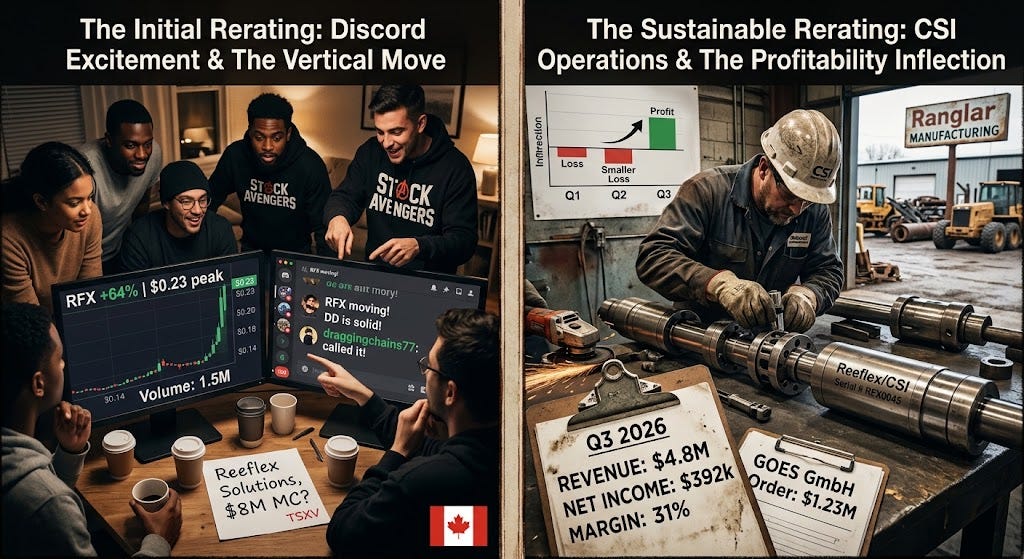
This Image Is obviously (satire)
There are two ways to tell the Reeflex Solutions story.
The easy one starts with the chart.
The better one starts before the chart moved.
Stock Avengers moderator draggingchains77 brought Reeflex Solutions Inc. (TSXV: RFX) to our attention. We opened a dedicated due diligence channel, and members began accumulating shares around $ 0.14- $ 0.145.
Then things moved fast.
Within roughly five trading sessions, RFX traded as high as $0.23, a maximum move of approximately 64% from the level where the Stock Avengers DD work began. It subsequently traded around $0.24 before the excitement cooled.
Today, it has worked its way back toward roughly $0.18.
That changes the chart.
It doesn’t erase what made the company interesting in the first place.
Not because somebody found an obscure ticker and the Discord piled into it. The discussion took off because people started seeing several things at once: a company valued at only around $8 million, a quarter showing $4.8 million of revenue and nearly $400,000 of net income, a potentially tight ownership structure, improving margins, an established operating business hidden inside a relatively new public listing, and manufacturing capabilities that management believes could extend beyond oilfield equipment into additional industrial markets.
The first day alone became a lesson in how quickly a neglected microcap can reprice when new investors begin paying attention. Members were watching Ventum, PI and Canaccord show up repeatedly on the buy side. Volume surged. By the end of that session, RFX was up roughly 36%, with about ten times its usual volume.
A few days later, Smallcap Discoveries featured Reeflex as a “Breakout Stock of the Week.”
The First Thing That Caught Our Attention Wasn’t the Story. It Was the Math.
When Reeflex first hit the DD channel, the reaction was almost immediate.
One member summed it up:
“8M market cap at .19 what a joke.”
Crude wording.
Fair question.
As of May 31, Reeflex had approximately 46.62 million shares outstanding.
At $0.18, that implies a basic equity value of only about $8.4 million.
Now compare that with what the actual operating company had just produced.
For Q3 fiscal 2026:
Revenue: $4.81 million
Gross profit: $1.49 million
Operating income: $453,725
Net income: $391,977
Those are filed numbers, not projections.
That doesn’t automatically make the stock cheap.
A company can trade at a tiny market capitalization because earnings are temporary, cash conversion is poor, debt is excessive, or its business is deteriorating.
So the valuation wasn’t the conclusion.
It was the reason to keep digging.
Then We Found the Part That Actually Matters: The Business Had Inflected
The year-over-year numbers for Reeflex are nearly useless.
CSI was only acquired on May 15, 2025, meaning the comparable Q3 period contained approximately two weeks of CSI’s operations. Reeflex’s $4.81 million of Q3 2026 revenue therefore compares with just $584,496 in Q3 2025.
Technically true.
Economically misleading.
The sequential progression tells us much more.
Fiscal 2026RevenueGross ProfitNet Income / LossQ1$2.90M~$0.56M($0.51M)Q2$3.10M~$0.85M($0.42M)Q3$4.81M$1.49M+$0.39M
The gross-margin progression is even more interesting.
Q1 was approximately 19%.
Q2 moved to roughly 27%.
Q3 reached approximately 31%.
That is what initially made the quarter stand out.
Revenue didn’t simply increase.
The incremental revenue arrived with dramatically better economics.
Reeflex went from losing $509,247 in Q1 and $421,349 in Q2 to earning $391,977 in Q3.
That is a meaningful inflection.
It is also only one quarter.
Those two statements can coexist.
This Is an Operating-Leverage Story Until Proven Otherwise
There is a point in many small industrial companies where scale suddenly starts mattering.
The corporate costs already exist.
The employees are already there.
The facility is already operating.
The machinery has already been purchased.
Then additional gross-profit dollars begin dropping through a cost base that doesn’t need to expand at the same rate.
That’s operating leverage.
Reeflex’s Q3 gives us our first meaningful evidence that it may be reaching that point.
Revenue rose materially from Q2.
Gross margin improved again.
And instead of producing another operating loss, Reeflex generated $453,725 of operating income.
That is what the DD channel was reacting to.
Not simply “oilfield equipment.”
Not simply “cheap stock.”
A tiny company appeared to be crossing from subscale losses into actual operating profitability.
If Q3 proves repeatable, that changes the economics.
If it doesn’t, the thesis changes with it.
Simple.
What Reeflex Actually Owns Is More Interesting Than the Ticker Suggests
The public entity is relatively new.
The operating business isn’t.
Reeflex owns Coil Solutions Inc., or CSI, an established manufacturer of coiled-tubing injectors, downhole tools, and related equipment. It also operates Ranglar Manufacturing, which focuses on custom mobile equipment.
The July investor update emphasizes the company’s existing oilfield business, global installed equipment base, aftermarket opportunity, and custom manufacturing capability. Management also highlights opportunities to apply the same engineering and manufacturing expertise in adjacent industrial markets.
This distinction matters.
RFX is not a pre-revenue company hoping somebody eventually buys its first machine.
CSI already sells equipment.
And once specialized equipment is operating in the field, the economic relationship with the customer doesn’t necessarily end when the original unit ships.
Parts wear out.
Equipment needs servicing.
Components get replaced.
Additional tools are purchased.
That installed base creates the possibility of aftermarket revenue.
Management specifically identifies that installed base and the associated aftermarket opportunity as a core part of the investment story.
The financial statements give us some evidence that this already exists.
During the first nine months of fiscal 2026, Reeflex generated revenue across injector builds, mobile equipment, downhole products, parts, servicing, rentals and other activities.
That mix is important.
A manufacturer depending entirely on new equipment builds deserves a different valuation from one that can build an increasingly valuable service-and-parts ecosystem around equipment already deployed.
We are not yet far enough along to assume the latter.
But we can see the pieces.
The $1.23 Million GOES Order Is a Useful Proof Point
On May 26, Reeflex announced that CSI had received an approximately $1.23 million purchase order from GOES GmbH for two 80K injector packages.
GOES isn’t a brand-new relationship.
It has been a CSI distributor and customer since 2015, and Reeflex previously announced an expanded international distribution relationship covering Europe and selected Eurasian and South Asian markets.
That makes the order more useful than a random one-off win.
It demonstrates that Reeflex’s existing equipment platform continues to have an international commercial channel.
More importantly, each successful deployment potentially adds another unit into the installed base from which parts and service demand can develop.
Potentially.
That’s the word that matters.
The purchase order is evidence.
Future aftermarket revenue is the opportunity.
Don’t confuse the two.
The Exciting Part of the DD Was Also the Part We Need to Treat Most Carefully
Once people began investigating Reeflex, the conversation quickly expanded beyond oil and gas.
Wildfire equipment was an immediate attention grabber.
Defense came up.
Data centres.
Mining.
Geothermal.
Members were essentially asking:
What else can this manufacturing platform build?
Management’s investor materials do support the broader concept: Reeflex describes opportunities to apply its engineering and manufacturing capabilities in adjacent industrial markets.
But investors need to draw a hard line here.
Wildfire, defense, data-centre, and other adjacent-market opportunities should not be valued as though they are already material recurring revenue.
Not from the evidence we currently have.
That’s upside optionality.
And optionality is much more attractive when you aren’t being asked to pay heavily for it.
Now We Get to the Part I Don’t Want Investors to Skip
RFX had only $113,381 of cash at May 31.
Against approximately $4.51 million of current liabilities.
At first glance, that sounds terrible.
But this is where reading the whole balance sheet matters.
Current assets totaled approximately $6.38 million, including:
$2.09 million of receivables
$3.63 million of inventory
and approximately $203,000 of prepaid expenses.
Reported working capital was therefore approximately $1.87 million.
So Reeflex isn’t balance-sheet insolvent.
But it also isn’t swimming in liquidity.
Its current assets are heavily tied to operating working capital.
That’s an important distinction.
This is a company that has to make its working capital work.
Collections matter.
Inventory turns matter.
Customer deposits matter.
Contract timing matters.
You cannot look at $1.87 million of working capital and pretend it is $1.87 million of cash.
The $1.4 Million Operating-Cash-Flow Number Needs an Asterisk
Through nine months, Reeflex reported approximately $1.40 million of cash generated from operating activities.
Excellent headline.
Less impressive underneath.
Before working-capital changes, the operating cash result was only approximately $96,000.
Receivables released about $920,000 of cash.
Inventory contributed approximately $221,000.
Deferred revenue contributed roughly another $420,000.
Those items did much of the heavy lifting.
That doesn’t mean the cash isn’t real.
It is.
Collecting receivables is supposed to produce cash.
Getting customer advances can be economically attractive.
Turning inventory into money is literally what a manufacturer is supposed to do.
But there is a huge analytical difference between:
“The business produced $1.4 million of recurring underlying cash flow.”
and
“The company generated $1.4 million of reported operating cash flow, substantially assisted by working-capital movements.”
The second statement is the one the evidence supports.
The next stage of the thesis requires Reeflex to begin generating more cash before relying on those working-capital releases.
Where Did the Cash Go? This Part Is Better.
Reeflex didn’t simply burn the cash.
It used a meaningful portion to reduce obligations.
During the first nine months of fiscal 2026, financing activities used approximately $1.30 million of cash.
That included roughly:
$1.06 million of promissory-note repayments
$280,000 of lease payments
and
$92,000 of loan repayments.
That matters because the CSI acquisition wasn’t free.
Reeflex paid for it using a combination of cash, shares and promissory notes.
The original consideration included:
$1.7 million cash
18 million common shares
a $2.3 million secured promissory note
and
a $638,241 secured vendor take-back note.
The vendor take-back was subsequently repaid, while acquisition-related obligations continue to decline.
This is the capital-allocation test Reeflex ultimately has to pass.
Buying CSI only creates shareholder value if the cash flow and earnings produced by CSI eventually exceed the full economic price Reeflex paid for it.
Q3 was encouraging.
It isn’t enough data yet to close the book.
The Share Structure Was Another Reason People Paid Attention
Digging into ownership.
Discussion centred around approximately 70% insider-aligned ownership, including the CSI vendor group.
Whether every percentage being passed around the channel should be treated as exact is less important than the underlying point:
people were trying to determine how much stock was actually available.
That matters enormously in a microcap.
The financial statements tell us the formal capital structure.
At May 31, Reeflex had approximately 46.62 million common shares outstanding.
There were also 3.05 million options at $0.20, expiring in May 2030.
And there were only 280,000 warrants at $0.10 remaining at the quarter end, with a July 2026 expiry.
The company also disclosed that only 220,000 new shares had been issued during the first nine months of fiscal 2026, for $22,000 of proceeds.
So the current picture is not one of a company continuously flooding the market with new paper.
That is important.
There is, however, a historical item investors shouldn’t ignore.
Reeflex issued 9 million shares valued at $1.8 million to an officer and director in consideration for providing a personal guarantee of the RBC facility.
That was a substantial financing-related economic cost.
At $0.18, Here’s the Question I’d Rather Ask
Forget where RFX traded last month.
Forget whether somebody bought at $0.14, $0.18 or $0.22.
The useful question is:
What does an $8.4 million company have to produce to make today’s valuation look wrong?
Q3 annualized mechanically would imply far more earnings than the current valuation would normally suggest.
But I would not annualize Q3.
Not yet.
The business is too lumpy.
The public history is too short.
The margin progression is too recent.
And the working-capital cash contribution is too important.
Instead, I’d frame it this way:
At approximately $0.18, the market is still assigning relatively little value to the possibility that Q3 represents the beginning of a sustainable operating run rate.
That creates the opportunity.
It also identifies exactly what can break the thesis.
What Has to Happen Next
The next phase of RFX does not need another exciting Discord day.
It needs confirmation.
First, gross margins need to hold.
The progression from roughly 19% to 27% to 31% is one of the most important things in the entire story. If margins retreat sharply, much of the operating-leverage thesis disappears.
Second, Reeflex needs another profitable quarter.
One profitable quarter proves possibility.
Several begin demonstrating a business model.
Third, cash generation needs to become less dependent on working-capital releases.
This may be the most important financial item to watch.
Fourth, the company needs to keep bringing acquisition debt down.
Every dollar that no longer belongs to lenders eventually gives shareholders more participation in the economics of the business.
Fifth, management needs to turn at least some of the adjacent-market discussion into evidence.
Wildfire.
Defense.
Data centres.
Mining.
Geothermal.
Great possibilities.
Now show us purchase orders, contracts or recurring revenue.
The Stock Came Back. The Due Diligence Didn’t.
The easiest time to become excited about Reeflex was when it went from $0.14 to $0.23 in a few days.
The more useful time to study it may be after that excitement fades.
The community did what it was supposed to do next.
People opened the filings.
They pulled apart the CSI acquisition.
They examined the ownership structure.
They watched the trading.
They challenged the valuation.
And the stock rerated almost immediately.
Now we get another test.
RFX is back around $0.18.
The market capitalization is back around $8 million.
But we still have the same Q3 showing $4.81 million of revenue, $1.49 million of gross profit, $453,725 of operating income and $391,977 of net income.
We still have improving sequential margins.
We still have an established manufacturing business.
We still have the international GOES relationship.
We still have the installed-base and aftermarket opportunity management is trying to expand.
And we still have the same weaknesses:
very little cash,
working-capital-heavy cash generation,
acquisition obligations,
limited public history,
and a business whose quarterly results can move meaningfully with contract timing.
That’s the setup.
Not perfect.
Not proven.
But very different from a speculative microcap with nothing more than a presentation and a promise.
RFX was interesting at $0.14.
The market figured that out quickly.
At $0.18, the question is no longer whether Reeflex can attract attention.
It already did.
The question now is whether the business can earn the rerating permanently.
Disclosure: Reeflex was brought to the Stock Avengers community by moderator draggingchains77. The Stock Avengers opened a dedicated RFX due-diligence channel, and members began accumulating shares around $0.14. Members of the community may own shares of Reeflex Solutions. No compensation was received from Reeflex for this article. This article reflects our interpretation of public filings, company disclosures, and independent due diligence and is not financial advice.