

Two acquisitions completed, a third awaiting TSXV approval, insiders and strategic partners backing the business, and management targeting $5 million in revenue and $1 million in profit. Here’s how the pieces are coming together, and why the next few quarters could change the way investors look at PVIS.
The Stock Avengers | October 23, 2026
What if FavorPoint isn’t the biggest opportunity in front of Parvis right now?
I’ve been following Parvis Invest Inc. (TSXV: PVIS) closely, and the more information we uncover, the more interesting the business becomes.
In the past year, Parvis has brought two significant investment businesses under its umbrella, attracted strategically connected shareholders, expanded its revenue streams and started consolidating operating costs.
It’s also working toward an ambitious financial target:
$4.9 million to $5.1 million in FY2027 revenue, with $900,000 to $1.1 million in net income.
And the proposed acquisition of U.S. broker-dealer FavorPoint Capital?
Not included in those numbers.
That’s an important distinction, especially when so much attention is being directed toward the time it’s taking to complete the U.S. transaction.
After reviewing the financial statements, management presentations, acquisition structures, investor interviews and our recent discussion with CEO David Michaud, I think there are two questions shareholders should be concentrating on.
How does PVIS deliver $1 million in profit?
And what happens to the opportunity if FavorPoint receives the necessary approvals?
Let’s follow the business, the money and the people involved.
The acquisitions aren’t just adding revenue. They’re changing what Parvis can sell.
Parvis generated $2.32 million in revenue during FY2026, an increase of approximately 143% over the previous fiscal year.
It also reduced operating cash consumption by approximately 56% and narrowed its annual net loss by 27%.
Importantly, these improvements occurred before its two most recent Canadian acquisitions were fully reflected in the financial statements.
That matters when looking at FY2027.
Richmond Global Wealth: April 2026
Parvis acquired Richmond Global Wealth for $800,000, issuing 1.6 million PVIS shares at a deemed price of $0.50.
Richmond brought additional wealth-advisory capabilities and relationships.
Why acquire a wealth-advisory business when Parvis already operates an investment platform?
Because distributing private investments is only one part of a broader financial-services relationship.
Clients may need portfolio advice, financial planning, investment selection and access to different products.
Richmond gives Parvis opportunities to provide more of those services.
The value isn’t simply the revenue Richmond was already generating. It’s what those capabilities can contribute when connected to the wider Parvis network.
Atlas One: August 2026
Atlas One was a different acquisition.
This was an established exempt market dealer operating in the same industry.
Parvis obtained its technology, investment offerings, issuer relationships, investors and existing business.
Management’s earlier presentation projected approximately $870,000 in FY2027 revenue from Atlas.
But the particularly interesting part is what David Michaud explained about the integration.
Atlas previously had approximately eight employees.
Following the acquisition, Parvis retained roughly three.
Michaud also identified overlapping regulatory, legal, insurance, technology and administrative expenses that could be removed.
Management expects approximately $500,000 in annualized integration efficiencies.
For a company targeting $1 million in annual net income, that is a meaningful part of the operating plan.
Those savings aren’t necessarily all incremental to the published forecast, and annualized savings are not the same as savings already realized.
But the integration strategy is tangible.
Parvis is combining two businesses that previously maintained overlapping infrastructure.
And there’s another detail I find interesting.
Michaud described Atlas’s existing book of business as underutilized.
That means the acquisition offers two opportunities.
Lower the cost of operating the acquired business.
Generate more revenue from the issuer and investor relationships it already had.
That’s where the economics begin to get interesting.
Management has shown us where almost $5 million in revenue is expected to come from.
One of the most useful pieces of information we’ve uncovered is an earlier management forecast breaking out the businesses individually.
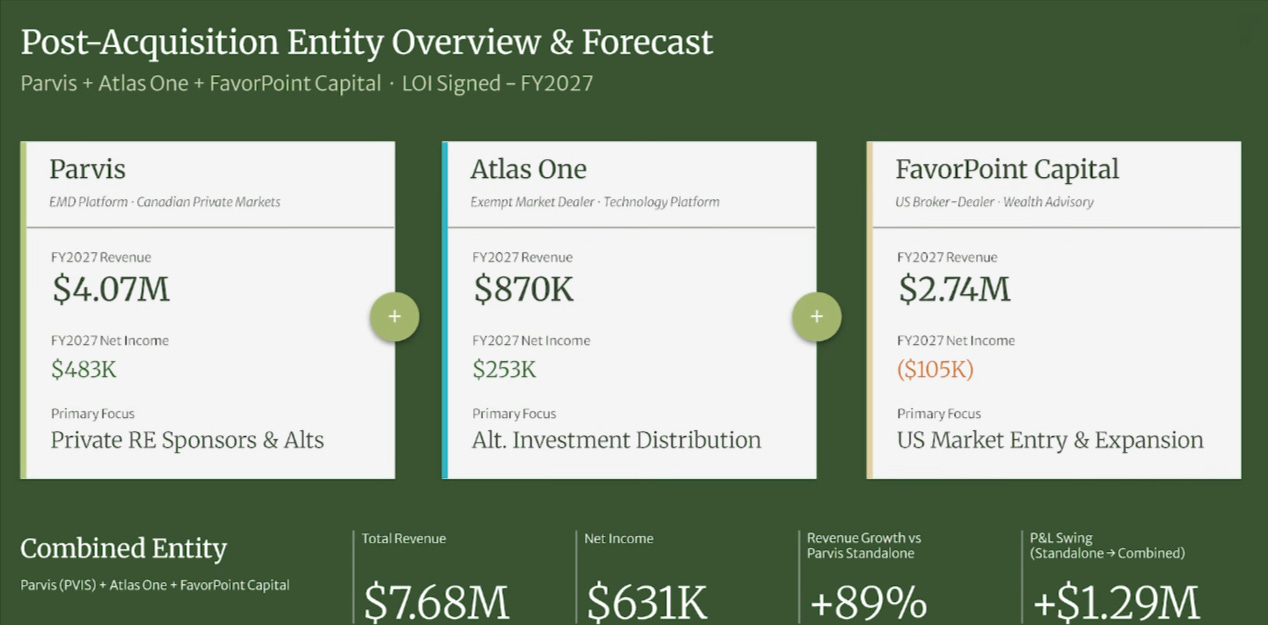
Look at the Canadian revenue figure.
$4.94 million.
That’s almost identical to the midpoint of management’s subsequently published $4.9 million–$5.1 million guidance.
The projections help explain where the revenue is expected to come from.
The more interesting difference is on the profit side.
The earlier presentation projected approximately $736,000 in combined Canadian net income.
The published August 26 guidance increased the net-income range to $900,000–$1.1 million.
At the midpoint, that’s approximately $264,000 in additional expected profit.
The detailed reconciliation hasn’t been disclosed in the material we’ve reviewed.
But the company’s integration program, broader service offering and efforts to improve efficiency provide important context for understanding management’s direction.
And remember, the Canadian business has more ways to generate revenue today than it did just a few years ago.
The hidden opportunity: More ways to get paid from the same investor relationship.
This might be the most overlooked part of Parvis’s transformation.
Many retail investors understand the basic model.
A private real estate fund wants to raise $20 million.
Parvis helps distribute the offering, processes the investment and receives fees.
But that’s no longer the entire story.
In FY2026, Parvis reported approximately:

Platform fees increased approximately 185% year over year.
Marketing and advisory services became additional revenue contributors.
Here’s why that’s important.
An investment manager doesn’t simply need capital.
It needs to find investors.
It needs compliant distribution.
It needs technology, onboarding, subscription processing and investor administration.
And it may need ongoing marketing and reporting support.
Parvis can provide multiple services around that relationship.
The same issuer can generate revenue from more than one service.
Now connect that to the acquisition strategy.
Richmond broadens advisory capabilities.
Atlas expands the issuer, investor and dealer network.
Parvis supplies shared technology and regulated infrastructure.
Marketing and ancillary services create additional ways to earn revenue across the combined customer base.
That’s the operating model behind the expansion.
And it’s why the company’s partnerships deserve serious attention.
Lankin Investments: Here’s what a productive partnership actually looks like.
Lankin Investments manages more than $2 billion in Canadian real estate assets.
It’s also a strategic investor and commercial partner of Parvis.
Lankin CEO Kyle Pulis joined Parvis’s board in 2025.
Recently, I found a job posting from Lankin for a Director, Private Capital Markets.
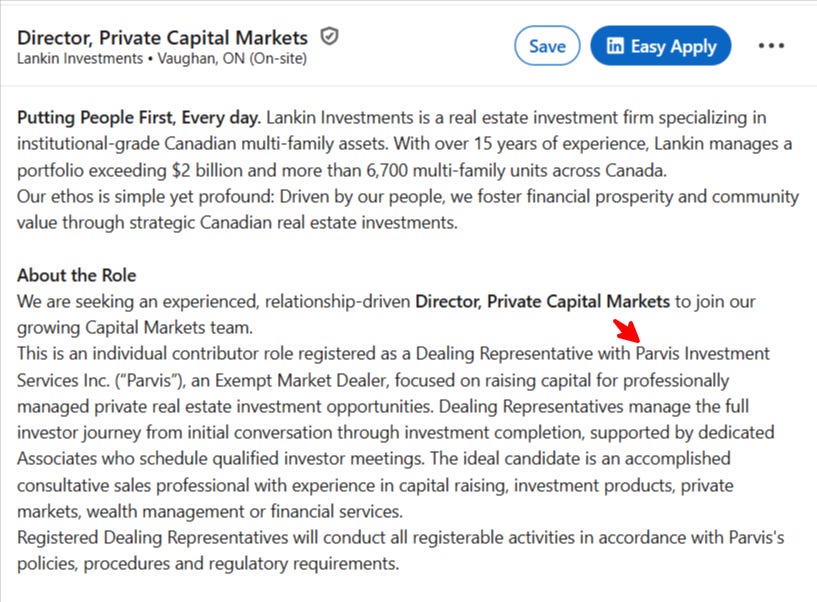
At first glance, it’s a capital-raising position.
But the job description contains an important detail.
The individual is employed by Lankin while conducting regulated securities-dealing activities as a Dealing Representative registered with Parvis Investment Services.
Think about how that works.
Lankin provides its investment products.
Lankin recruits and supports the capital-raising professionals.
Those professionals conduct regulated dealing activities through Parvis.
Parvis provides the registered dealer framework, supervision and applicable services.
And Parvis earns fees under the commercial relationship.
The $2 billion in assets managed by Lankin isn’t Parvis revenue.
What matters is the investment activity and services conducted through the arrangement.
But we’re seeing something more useful than another partnership announcement.
An established outside investment manager is actively building capital-raising capacity around Parvis’s dealer infrastructure.
And that model isn’t restricted to one real estate company.
Private-credit funds, mortgage investment corporations, private equity managers and other alternative-investment sponsors can use similar services.
That’s how the same infrastructure can support multiple revenue-generating relationships.
It also helps explain why management is interested in expanding beyond real estate.
Real estate was the starting point. It doesn’t have to be the destination.
In a recent interview, Parvis management discussed the opportunity to offer a broader range of private investments.
Private credit.
Private equity.
Infrastructure.
Farmland.
Industrial and other specialized real estate.
The strategic significance isn’t simply putting more investment offerings on a website.
It’s that different investors have different objectives.
Some want exposure to income-producing apartments.
Others are interested in secured private credit.
Others may prefer farmland or infrastructure investments associated with utilities, transportation or other long-lived assets.
And those investment categories bring different issuers and fund managers into the market.
Parvis can potentially serve them through much of the same underlying technology and registered dealer infrastructure, subject to the applicable product and regulatory requirements.
Management specifically identified farmland and infrastructure as areas of interest.
Farmland was described as a future product opportunity rather than something already available on the platform at the time of the interview.
That’s an important distinction.
But consider the business opportunity.
More investment categories can attract more issuers. More issuers create more opportunities for platform, marketing and distribution revenue.
And a wider range of eligible investments may give existing investors more reasons to remain active within the Parvis network.
The same platform becomes useful to more types of customers.
But here’s where the story could become even more interesting.
The secondary market: One investment doesn’t necessarily mean one transaction.
Private investments have a familiar problem.
Liquidity.
Someone invests in a private real estate fund and may be committed for years.
Another investor owns shares in a private company but has no conventional public market in which to sell.
Someone inherits private investments they don’t particularly want to hold.
Or an investor wants to rebalance their portfolio.
Parvis is developing secondary-market infrastructure intended to facilitate eligible transactions in existing private securities.
Management has discussed several applications.
Selling eligible private-fund holdings before their expected maturity.
Facilitating permitted transactions involving employee-held private-company shares.
Helping investors rebalance between private investment categories.
Potentially assisting with transfers involving inherited private investments.
Some of those applications remain prospective rather than established commercial services.
But the opportunity is easy to understand.
Parvis may eventually earn revenue when certain securities are originally distributed and again when those same securities are subsequently traded.
That’s an important extension of the business.
Instead of relying exclusively on new investment capital entering the marketplace, secondary transactions could create activity involving existing holdings.
And management has indicated that further secondary-market development is a priority after acquisition integration.
Now connect all the pieces.
A broader selection of products attracts issuers and investors.
Partnerships help generate distribution activity.
Ancillary services generate additional revenue from issuer relationships.
Secondary-market capabilities could create further transactions over the life of an investment.
That’s the vision: not merely a website where people purchase private investments, but a broader infrastructure business supporting how those investments are distributed, administered and potentially transferred.
And with that in mind, let’s return to the immediate numbers.
What does management need to deliver over the next three quarters?
Parvis’s fiscal year ends March 31, 2027.
For Q1, ended June 30, the company reported:
Revenue: $564,182.
Net loss: $297,334.
Management’s full-year midpoint is approximately $5 million in revenue and $1 million in net income.
That leaves:
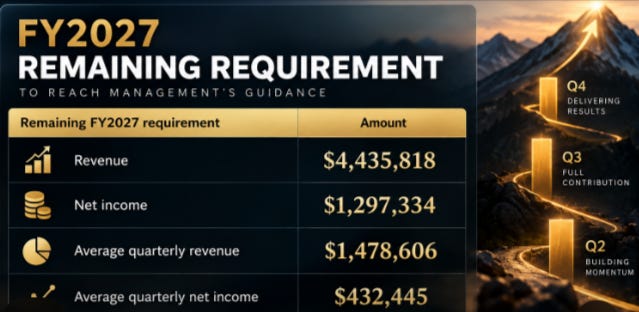
The timing of the acquisitions matters.
Richmond was included in Q1 following its April closing.
Atlas wasn’t acquired until August 13.
That means Q2 includes only part of Atlas’s operating contribution.
Q3 will be the first full quarter following the Atlas acquisition.
So the full-year guidance doesn’t imply identical revenue and earnings in each remaining quarter.
Here’s what different Q2 revenue outcomes would mean for the final two quarters.
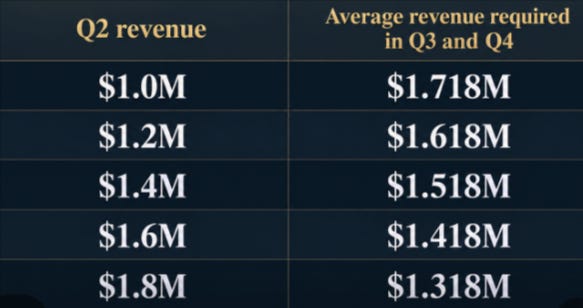
These are illustrative calculations based on the guidance midpoint.
They provide a practical way to measure how the business is progressing toward its published target.
And during our October 21 discussion with David, he acknowledged that FY2027 guidance is ambitious while expressing confidence in the company’s ability to achieve it.
My understanding is that management sees the path through partnership activity, the enlarged distribution network, integration and greater discipline around profitability and cash flow.
That combination is where shareholders should be concentrating their attention.
What about the insiders? The ownership picture is worth understanding.
Parvis has been financing its expansion through a combination of strategic investment, convertible debt and shares issued directly to acquisition vendors.
The transactions themselves reveal some useful information.
Richmond Global Wealth
Parvis issued 1.6 million common shares at a deemed $0.50, representing $800,000 in acquisition consideration.
Of those shares, 1.12 million went to Bluestar Equity.
Bluestar was already strategically connected to Parvis.
Atlas One
The initial consideration included 4,761,905 shares at a deemed $0.525.
Atlas vendors also received 2,083,333 warrants exercisable at $0.70.
And the agreement includes $2.5 million in deferred consideration payable, at Parvis’s option, in cash or through an additional 4,166,667 shares at a deemed $0.60.
Certain Atlas principals also accepted multiyear restrictions on their acquisition securities, extending into 2028, 2029 and, for applicable deferred securities, 2030.
These negotiated values aren’t equivalent to open-market purchases at those prices.
But the vendors accepted substantial exposure to PVIS rather than receiving all negotiated consideration in cash upfront.
That is an important part of the transaction structure.
What about David’s personal ownership?
In November 2025, Parvis disclosed that Michaud held 4,212,670 shares, representing approximately 15.7% of the company at that time.
He had also accumulated approximately 1.47 million shares through market purchases since May 2023.
But it establishes that the founder had accumulated a meaningful equity position, including shares purchased personally.
And the strategic investors?
Bluestar Equity and Lankin Investments became strategic investors in 2025.
Their involvement wasn’t limited to passive share ownership.
The relationship included capital, board representation and commercial partnerships.
Parvis also completed $700,000 in strategic convertible-debenture financing across 2025 and 2026, which management later confirmed had converted into common shares.
The tranches carried conversion terms ranging from early $0.06 eligibility to later $0.20 and $0.35 conversion prices.
Those are different financing economics from the $0.50–$0.60 deemed prices in the acquisition agreements.
And understanding that distinction is important when looking at who owns the shares.
The most recent financing is especially interesting.
Parvis announced a new convertible-debenture financing of up to $3 million.
The terms included:
10% annual interest.
$0.55 conversion price.
$0.65 warrants.
Two-year maturity.
On August 13, Parvis closed the first tranche for $175,000.
The proceeds were directed toward Atlas One integration and working capital.
And here’s the detail investors should know.
On August 10, the company said directors were expected to participate for $125,000 of the first tranche.
At the August 13 closing, director participation was confirmed.
Approximately 71% of the completed tranche.
That’s worth paying attention to.
The debentures aren’t equivalent to directors buying ordinary shares outright at $0.55. Investors also receive the debt interest and warrant rights.
But the participation demonstrates that directors were involved in the financing.
And there is another point I’ve been examining closely.
The additional financing wasn’t paused because the company publicly announced that investors had lost interest.
It was paused while FavorPoint remained under TSXV review.
Which brings us to the second major question shareholders have been asking.
Is FavorPoint actually going to close?
The proposed acquisition of FavorPoint Capital remains in the TSXV review process, with FINRA approval and other conditions also required.
Some have interpreted the delay as evidence that the transaction is going badly.
But after examining the acquisition history and discussing the situation with David, I think the distinction between a regulatory delay and a failed transaction is important.
Michaud previously described Richmond Global Wealth as having taken approximately four months to work through its transaction process.
FavorPoint involves a U.S. registered broker-dealer, which adds regulatory complexity.
Based on our October 21 discussion, my understanding is that the TSXV review remains the immediate bottleneck.
A transaction under TSXV review is not the same thing as a transaction that has been rejected.
And what’s especially interesting is the financial opportunity involved.
In an earlier management presentation, FavorPoint was projected to generate:
$2.74 million in FY2027 revenue.
That’s equivalent to approximately 55% of the projected Canadian revenue midpoint.
The same presentation projected a $105,000 net loss for FavorPoint, so its immediate appeal was primarily market expansion rather than additional near-term earnings.
And remember:
FavorPoint isn’t included in the company’s published Canadian revenue or net-income guidance.
The Canadian business is being forecast on its own.
FavorPoint would provide an additional avenue for expansion if the transaction closes and its commercial potential is realized.
But it isn’t the only route Parvis has toward U.S. opportunities.
The U.S. opportunity doesn’t begin and end with FavorPoint.
In September 2025, Parvis announced a Rule 15a-6 chaperoning arrangement that enables certain U.S. institutional-market activities through a registered U.S. broker-dealer.
That arrangement is more limited than owning a U.S. broker-dealer.
But it demonstrates that the company already has an established regulatory framework for certain cross-border institutional opportunities.
FavorPoint would give Parvis additional capabilities and more direct control over a U.S. broker-dealer operation.
And establishing a separate U.S. registered dealer through the FINRA membership process is another possible route, albeit one involving regulatory, capital and operational requirements.
So the strategic objective is broader than completing one transaction.
Parvis wants to connect Canadian private-investment issuers with a larger North American investor market, while also developing relationships with U.S. issuers and sponsors.
FavorPoint could be an important step toward that objective.
And the financing strategy has been tied to its timing.
The $3 million financing: Here’s what people seem to be misunderstanding.
The company announced convertible-debenture financing of up to $3 million.
It closed the first $175,000 tranche for Atlas integration and working capital.
The remaining amount was not drawn.
In its August 26 update, Parvis explained that it wasn’t proceeding with additional tranches at that time because those funds were principally intended to support FavorPoint.
That is the company’s disclosed reason for the pause.
Based on my October 21 conversation with David, my understanding is that financing interest remains available and management has other possible financing routes if required.
That is information from my due diligence, rather than a public confirmation that the full remaining amount is irrevocably committed.
But it’s an important distinction.
Also keep in mind they have never gone to market or done a deal without it being valued higher VS the current SP.
Deferring additional financing while the intended acquisition remains under review is not the same thing as announcing that investors are unwilling to finance the company.
And there is another crucial statement in management’s published guidance.
The Canadian FY2027 forecast does not depend on completing additional financing.
That doesn’t mean the company no longer needs to manage working capital carefully.
It means management has built its Canadian operating forecast around the businesses it already controls.
The proposed U.S. transaction and the remaining financing tranches are separate parts of the expansion strategy.
And that’s how shareholders should evaluate them.
Let’s look at the share structure.
From the June 30 financial statements and the initial Atlas share issuance:
Basic share-count June 30, 2026 reported shares 35,115,056 Atlas acquisition issuance +4,761,905 Illustrative post-Atlas basic shares 39,876,961
That gives us approximately 39.9 million common shares before subsequent issuances.
At an illustrative share price of $0.19, Parvis would have an equity market capitalization of approximately $7.58 million.
Now consider management’s FY2027 net-income midpoint of $1 million.
That’s approximately 7.6 times projected annual net income on the illustrative basic share count.
The share count is not fully diluted.
Options, warrants, convertible debt and potential deferred acquisition shares need to be included in a complete capitalization analysis.
But the valuation comparison helps illustrate why management’s profitability guidance is so relevant to shareholders.
At that market capitalization, $1 million in sustainable annual earnings would represent a meaningful change in the company’s financial profile.
The central question is execution.
And that’s where the next two quarterly reports come in.
The next financial statements should make this much easier to evaluate.
The quarter ended September 30 will give us the first post-acquisition financial contribution from Atlas One.
The December quarter should provide a clearer picture of the enlarged Canadian business over a full reporting period.
The goal is to generate more revenue from a larger network while reducing the cost of operating that network.
That’s the business model shareholders need to understand.
And if that happens, the financial contribution from future investment categories, secondary-market activity and U.S. expansion could provide additional opportunities beyond the existing Canadian forecast.
Here’s what we hope investors take away.
Parvis has spent the last few years assembling the pieces of a larger private-capital infrastructure business.
It now has Canadian wealth-advisory capabilities.
An enlarged exempt-market dealer network.
More issuers, advisors and qualified investors.
Strategic partners actively building capital-raising capacity through its infrastructure.
Growing ancillary-service revenue.
An integration program intended to eliminate overlapping costs.
And a developing secondary-market strategy that could create more activity from investments already held by clients.
On top of that, FavorPoint could provide direct U.S. broker-dealer capabilities and a substantial additional revenue opportunity.
But the immediate earnings story is Canadian.
Management is guiding for approximately $5 million in FY2027 revenue and $1 million in net income from the consolidated Canadian business.
It has already completed the acquisitions supporting that forecast.
It has identified opportunities to reduce expenses and expand revenue per issuer.
And it has a published financial target against which shareholders can measure progress.
The U.S. transaction remains in TSXV review.
The additional financing tranches have been TEMP deferred while that process continues.
But the operating integration and commercial expansion are already underway.
That’s the distinction I find most interesting.
Parvis isn’t waiting for FavorPoint to begin proving the Canadian business.
The acquisitions are completed.
The partnerships are established.
The revenue streams are expanding.
And the next financial reports will show how those pieces are coming together.
For me, that’s what makes this worth following.
Not simply the possibility of another acquisition.
**The possibility that Parvis is approaching the point where the infrastructure it has spent years assembling begins producing meaningful revenue.
approx. 55-60% insider holdings