

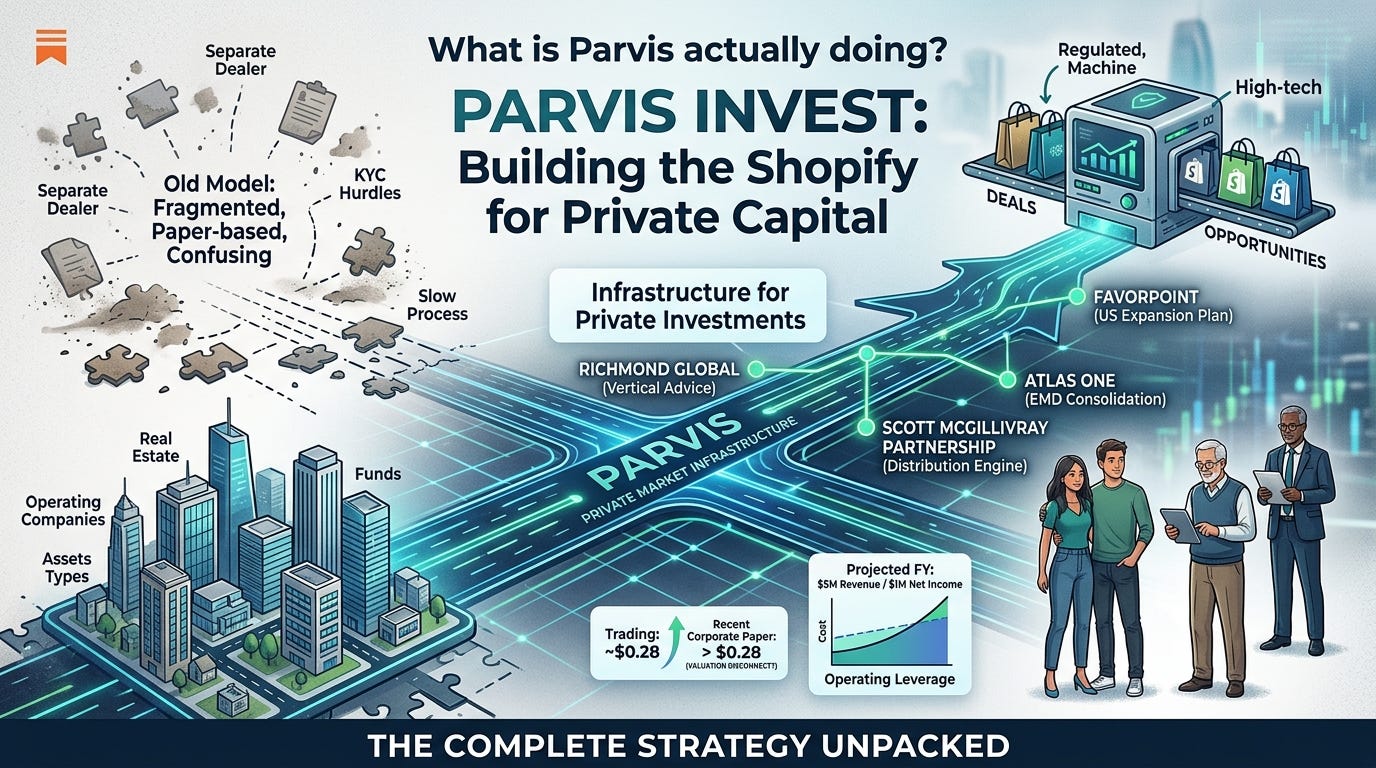
If you've been following Parvis Invest for the last six months and still aren’t completely sure what the company does, I don’t blame you.
The news flow has been relentless.
A wealth management acquisition.
A Scott McGillivray distribution agreement.
Another Canadian dealer.
A U.S. broker-dealer.
A financing.
Different financing terms.
Another acquisition agreement.
An acquisition closing.
Then, suddenly, management tells investors that the combined company should generate roughly $5 million in revenue and $1 million in net income this fiscal year.
Meanwhile, PVIS is trading around $0.28.
And almost every meaningful piece of corporate paper issued recently has been priced well above that.
So what in the hell is actually going on?
Is Parvis a fintech?
A wealth manager?
An investment dealer?
A roll-up?
A marketplace?
A SaaS company?
A private-equity platform?
The easiest answer is also the most useful:
Parvis is trying to build the distribution infrastructure for private investments.
That sentence explains almost everything that has happened.
And once you put the announcements in the correct order, the strategy stops looking scattered.
It starts looking remarkably deliberate.
Start With the Problem Parvis Is Trying to Solve
Public-market investing is easy.
You open an account.
You search for a ticker.
You click buy.
Private-market investing is nothing like that.
A private real estate fund, private lender, operating company or alternative investment that wants to raise capital has to find investors.
Those investors need to qualify under the appropriate securities exemptions.
Someone has to perform KYC.
Someone has to understand the product.
Suitability has to be assessed.
Subscription documents have to be signed.
Money has to be transferred.
Regulatory requirements differ by jurisdiction.
Marketing private securities creates another layer of compliance.
And traditionally, much of that private-market infrastructure has been fragmented.
Different issuer.
Different paperwork.
Different back office.
Different dealer.
Different account.
Different process.
Parvis is trying to put much of that into one regulated system.
CEO David Michaud described it very simply in the more recent French-language interview: Parvis does the “matchmaking” between private issuers that need capital and investors looking for private investment opportunities. It adds compliance, technology, and marketing/distribution around that transaction.
That’s the business before we add any buzzwords.
Think of It as Infrastructure, Not an Investment Product
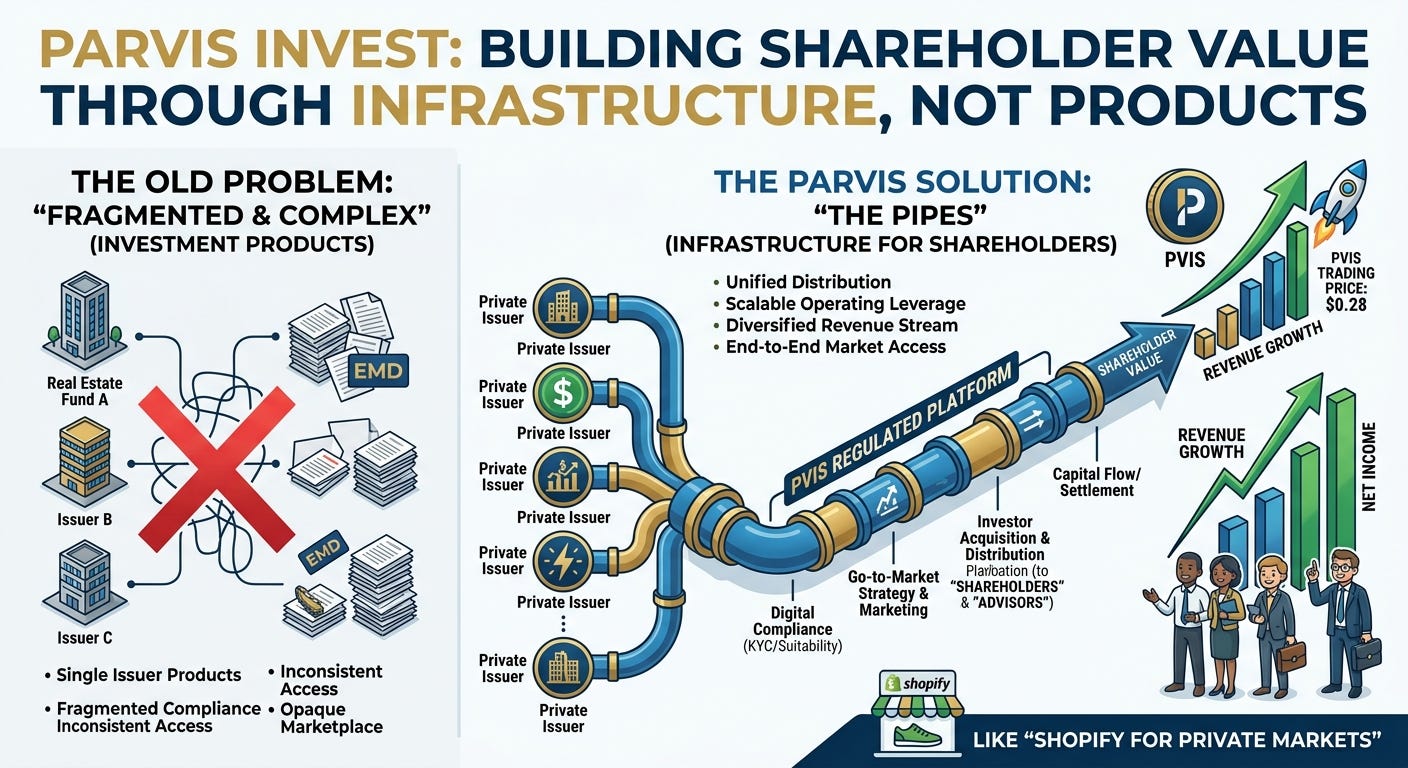
Parvis does have its own investment products.
But that isn’t the biggest idea.
The bigger idea is to become the infrastructure through which other people’s private investment products are distributed.
There was a comparison in the recent interview that actually works remarkably well:
Shopify for private markets.
Shopify doesn’t need to manufacture the shoes, jewellery or furniture sold by its merchants.
It provides infrastructure that helps merchants sell.
Parvis doesn’t need to own every apartment building, private lender or investment fund on the platform either.
Its opportunity is to provide the regulated infrastructure that helps private issuers bring those investments to market.
An issuer can potentially come to Parvis and get help with:
product structure,
compliance,
legal coordination,
technology,
marketing,
investor acquisition,
distribution,
subscription processing,
money movement,
and potentially secondary-market liquidity.
Michaud described the model as an end-to-end go-to-market strategy for private investments.
That is a much better way to understand Parvis than simply calling it a “real estate fintech.”
Real estate was the starting point.
The infrastructure is the business.
April 2: Before Most of This Happened, Management Told Us the Plan
This is where the story gets much more interesting.
On April 2, 2026, David Michaud appeared on a Smallcap Discoveries call.
At the time:
PVIS was around $0.22.
The company had roughly 31.9 million shares outstanding.
Its market capitalization was about $7 million.
Atlas One had not been announced.
FavorPoint had not been announced.
The current acquisition program wasn’t yet visible to public shareholders.
And Michaud explained what Parvis intended to do.
He said the Canadian exempt-market-dealer industry was fragmented.
He said many smaller dealers were inefficient.
Some lacked modern technology.
Some depended heavily on a small number of people or distribution relationships.
Some lacked succession planning.
And he said Parvis believed the industry could be consolidated.
More importantly, he said Parvis was already looking at competitors, books of business, technology and teams that could be integrated into the platform.
He also said international expansion was on the roadmap.
And when asked whether Parvis might need to raise money, he gave a fairly specific answer:
there was no immediate financing need at the time, but a large acquisition could cause the company to go to market for additional capital.
Remember those three things:
Consolidate Canadian competitors.
Expand outside Canada.
Raise capital if a large acquisition requires it.
Then watch what happened.
Four Days Later: Richmond Global Wealth Closed
On April 6, Parvis completed the acquisition of Richmond Global Wealth.
The price:
1.6 million PVIS shares
at a deemed:
$0.50 per share
for approximately:
$800,000 of consideration.
This was not simply Parvis buying another version of itself.
Richmond added a different capability.
Parvis historically focused on private investments.
Richmond broadened the relationship into wealth, tax and investment advisory services.
Why does that matter?
Because somebody who comes to Parvis to buy one private investment has an entire financial life outside that transaction.
Public securities.
Funds.
Tax planning.
Portfolio allocation.
Financial advice.
If Parvis only owns the private transaction, it touches one piece of the investor.
Richmond potentially allows the company to participate in more of the relationship.
This was vertical integration.
Not yet consolidation.
That came next.
April 21: Scott McGillivray Showed What the Distribution Engine Is Supposed to Do
Parvis then signed an agreement to act as a primary distribution partner for investment products associated with Scott McGillivray’s McGillivray Capital Partners.
Parvis would help distribute the offerings across Canada, including Quebec.
This announcement looks less important than an acquisition.
Strategically, it may be one of the cleanest examples of the model.
McGillivray Capital Partners has the investment product.
Parvis provides distribution infrastructure.
That is exactly what you want if the real opportunity is to become the pipes rather than manufacture everything flowing through them.
The long-term question isn’t:
How many funds can Parvis create itself?
It’s:
How much capital can move through Parvis’ infrastructure?
That distinction becomes critical later.
April 22: A Reminder That Growth Still Required Capital
One day later, Parvis closed another $300,000 tranche of an older convertible-debenture financing, bringing that financing to $600,000 closed at the time.
The proceeds were earmarked for working capital, technology-platform development and expansion.
This is worth remembering because the Parvis story has two things happening simultaneously:
the business is scaling,
and
the balance sheet has historically been weak.
Those two truths have existed together throughout this story.
May 11: Then the Actual Consolidation Started
On May 11, Parvis announced an agreement to acquire Atlas One Digital Securities.
Now the April interview mattered.
Atlas was exactly the sort of company Michaud had described five weeks earlier.
Another Canadian exempt market dealer.
Another private-market platform.
Another issuer network.
Another investor network.
Another technology stack.
Another set of regulatory and administrative costs.
The initial transaction contemplated approximately $5 million of consideration.
This wasn’t Parvis wandering into a new industry.
This was Parvis executing the consolidation strategy management had already publicly described.
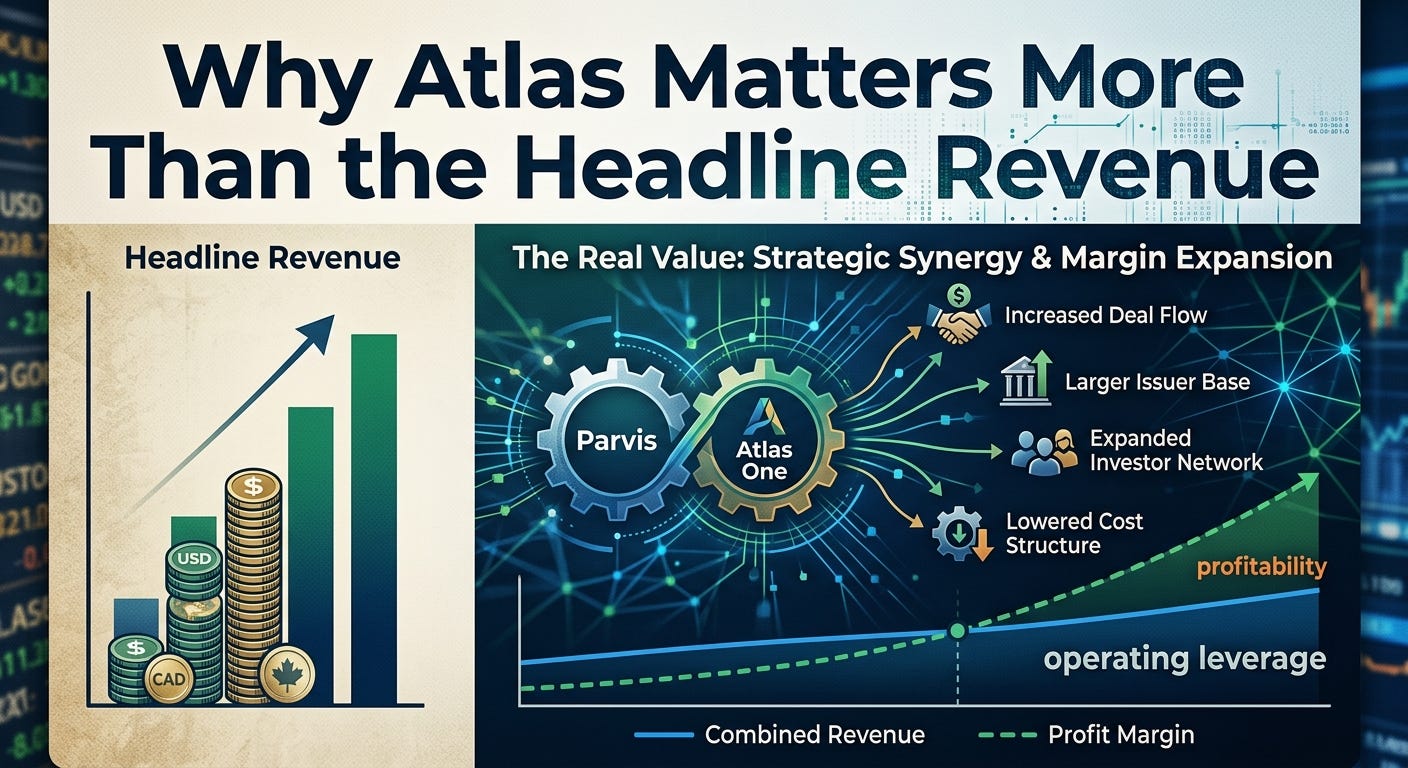
The obvious way to describe Atlas is:
Parvis bought another EMD.
But that misses the economic point.
Suppose Parvis and Atlas each need their own:
compliance infrastructure,
technology,
KYC systems,
legal support,
insurance,
regulatory administration,
back office,
and management overhead.
Running two separate companies means paying for much of that twice.
If you can move Atlas’ issuers, investors and transactions onto Parvis’ existing infrastructure and eliminate duplicated costs, something interesting happens:
Revenue can increase faster than overhead.
That is operating leverage.
And that is the entire economic theory behind this acquisition.
Management later quantified the target:
approximately $500,000 of annualized operating efficiencies.
The important question is therefore not simply whether Atlas adds revenue.
It’s whether Parvis can keep the Atlas economics while removing a meaningful part of the Atlas cost structure.
If it can, the acquisition could be highly accretive.
If it can’t, Parvis merely bought more activity.
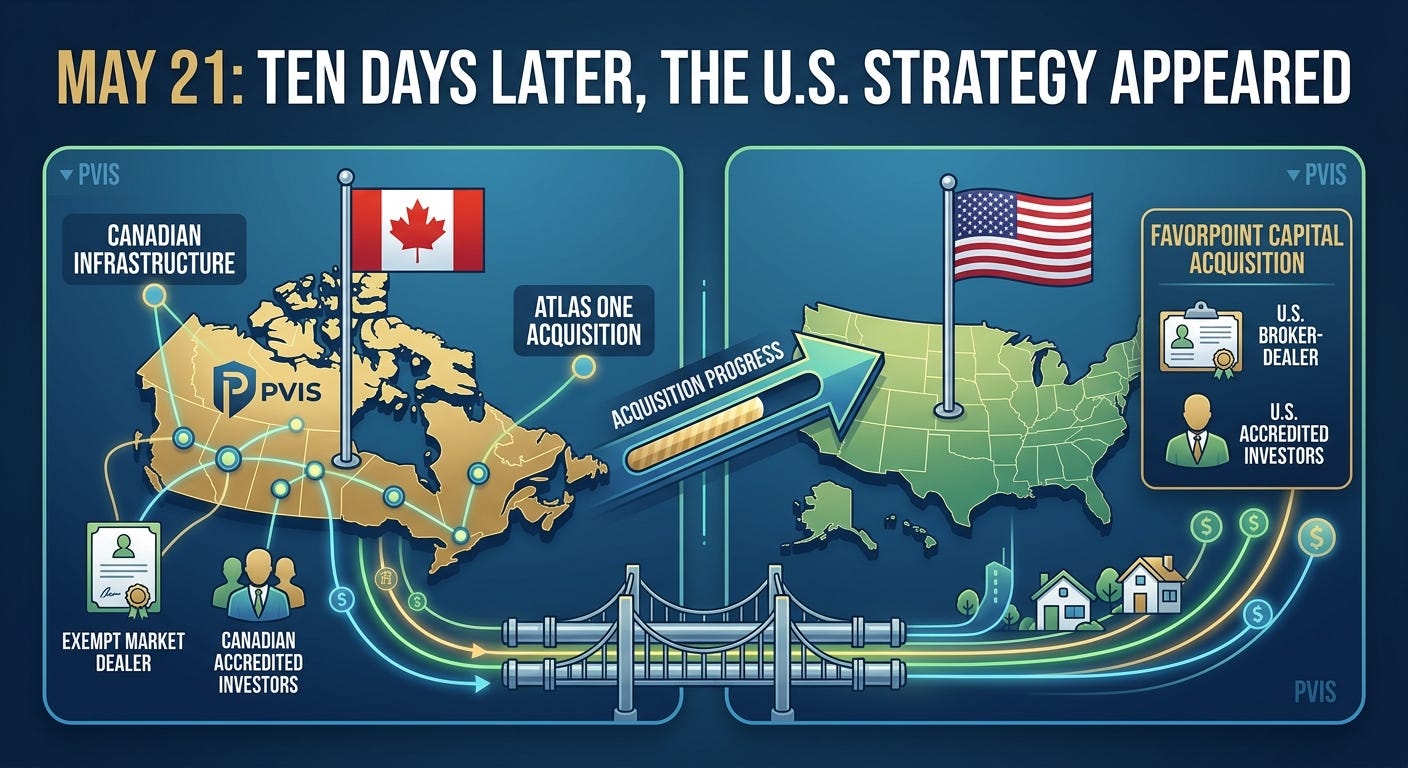
Before investors had much time to digest Atlas, Parvis announced another transaction.
FavorPoint Capital.
FavorPoint is a FINRA-registered U.S. broker-dealer.
This was the second part of the April blueprint.
Michaud had told investors that geographic expansion was something he wanted to pursue.
Now we knew how.
Parvis already had Canadian regulatory distribution infrastructure.
FavorPoint is intended to provide a regulated U.S. distribution relationship.
Management said the transaction could allow issuers to access both Canadian and U.S. accredited investors through a more integrated structure.
This is an important distinction:
Atlas increases Canadian scale.
FavorPoint is supposed to increase geographic reach.
Those aren’t the same acquisition repeated twice.
They solve different problems.
May 28: Then Came the Financing Michaud Had Already Warned Could Happen
One week later, Parvis announced a financing of up to:
$3 million
to support its North American expansion strategy.
Again, go back to April.
When asked about financing, Michaud hadn’t said:
We will never need money.
He said Parvis had no immediate financing requirement but could raise capital if it pursued a large acquisition.
Then Parvis announced Atlas.
Then FavorPoint.
Then financing.
You can disagree with the strategy.
You can question the dilution.
But the sequence matters.
This wasn’t an emergency financing suddenly appearing after management told investors the company was fully funded.
It was much closer to what management had described beforehand.
June 22: FavorPoint Became a Definitive Deal
On June 22, Parvis moved from the FavorPoint letter of intent to a definitive purchase agreement.
The transaction remained subject to regulatory approval.
That distinction remains important today.
FavorPoint is still not part of the operating numbers we should use to value the current company.
Management later excluded FavorPoint entirely from its FY2027 guidance.
So the U.S. business is still a potential next layer.
It is not required for the current Canadian thesis to work.
June 30: The New Financing Was Rewritten
The financing was subsequently restructured into unsecured convertible debentures.
The key equity-linked terms became:
$0.55 conversion price
and:
$0.65 warrants.
Keep those prices in mind.
We’ll come back to them.
July 2: Atlas Became Definitive
Parvis signed the definitive Atlas agreement.
The strategic language became clearer:
Richmond broadened the financial products Parvis could provide.
Atlas deepened the exempt-market infrastructure and national distribution network.
This is where the architecture really becomes visible.
Parvis wasn’t simply assembling revenue.
It was adding different pieces around the same core transaction.
July 30: Then the Financial Statements Told Us What the Old Parvis Actually Looked Like
This is where we need to separate the exciting strategy from the financial evidence.
Fiscal 2026 revenue increased:
143% to $2.316 million.
Platform-fee revenue increased to approximately:
$1.853 million
or about 80% of revenue.
Management also pointed out that G&A increased much more slowly than revenue and that Parvis had posted a profitable quarter during the year.
That is real operating progress.
The business was substantially larger than a year earlier.
But it was not yet self-funding.
For fiscal 2026, Parvis still lost approximately:
$1.16 million.
And the June-quarter financial position remained weak.
At June 30, Parvis had only about:
$111,000 of cash
against more than:
$1.17 million of current liabilities.
Working capital was negative.
Operating cash flow remained negative.
There was also a regulatory-capital shortfall at the operating subsidiary.
This matters enormously.
The old Parvis was improving.
But the old Parvis had not yet crossed the line into a financially self-sustaining company.
So Atlas wasn’t simply an optional growth acquisition.
It became the major test of whether scale could finally change the economics.
August 13: Atlas Actually Closed
This is where the story moved from strategy into execution.
Parvis completed the acquisition of Atlas One after satisfying the required closing conditions, including regulatory non-objection and TSXV acceptance.
At closing, Parvis issued:
4,761,905 shares at $0.525
plus:
2,083,333 warrants exercisable at $0.70.
Then comes an unusual second piece.
On the first anniversary of closing, Parvis can choose to pay:
$2.5 million cash
or issue:
4,166,667 additional shares at a deemed $0.60.
That structure matters because management has preserved a choice between cash and dilution.
Which option eventually makes more sense will depend heavily on whether the combined business actually becomes cash-generative.
And Something Else Happened on August 13
Parvis also closed the first tranche of the new convertible financing.
How much?
Not $3 million.
Not $2 million.
Not $1 million.
$175,000.
The proceeds were directed toward working capital for Atlas integration.
That becomes much more meaningful two weeks later.
August 26: Management Finally Told Us What the New Company Is Supposed to Earn
This was probably the most important release of the entire sequence.
Parvis issued its first FY2027 guidance for the combined Parvis + Atlas business.
Revenue:
$4.9 million to $5.1 million
Net income:
$900,000 to $1.1 million
FavorPoint:
Excluded
Further financing required to hit the guidance:
Management says no.
At the midpoint, management is telling us to expect approximately:
$5 million of revenue
and:
$1 million of net income.
That is approximately a:
20% net margin.
Now compare that with FY2026:
$2.316 million revenue
and approximately:
$1.16 million net loss.
Management is not forecasting a small improvement.
It is forecasting an economic regime change.
That’s the investment.
So What Changed Between the Old Parvis and the New Parvis?
The answer is scale plus consolidation.
The old company had built the infrastructure.
By April, management said Parvis had roughly:
55 private issuers
close to:
50 licensed advisors
and had facilitated approximately:
$120 million of capital during calendar 2025.
At the time of that April presentation, Michaud laid out a formal five-year ambition of roughly:
$2 billion of annual platform volume
which he said could translate into just under:
$15 million of annual revenue.
That implied something important:
Parvis wasn’t trying to become successful by extracting huge fees from a tiny amount of activity.
It wanted volume.
More capital through the pipes.
More issuers.
More investors.
More transactions.
More services around those transactions.
Atlas is one way to accelerate that.
FavorPoint is another.
The Later Interview Shows the Ambition Has Become Even Larger
In the more recent French-language interview, Michaud describes an even larger long-term aspiration:
approximately:
$4 billion to $5 billion of annual transaction volume.
He also describes the Canadian market explicitly as a consolidation opportunity and says Parvis wants to become the place people think of when they want to access private investments.
I would not treat the $4B-$5B number as formal guidance.
It isn’t.
And it is higher than the more formal $2B five-year roadmap discussed in April.
But the progression is interesting.
Before Atlas and FavorPoint were public, management’s roadmap contemplated roughly $2B of annual throughput.
After moving aggressively into consolidation and cross-border expansion, Michaud began talking about a potential destination twice that size.
That’s not something I would model.
But it tells us what management believes the architecture could eventually support.
So How Does Parvis Actually Make Money?
This is where the two interviews help enormously.
There is no single Parvis “take rate.”
Different services generate different economics.
Michaud explained in April that pure compliance/processing work can generate around:
1%
of the capital processed.
Full capital-raising assignments can generate approximately:
5%-9%
before sharing economics with licensed advisors.
Parvis can also earn:
technology/platform fees,
marketing fees,
and advisory revenue.
In the later interview, Michaud similarly describes issuer-paid fees that vary depending on how much of the process Parvis handles.
So think about Parvis this way:
At the low end:
It can simply provide compliant infrastructure and processing.
At the higher end:
It can help structure the investment, market it, find investors, distribute it and process the entire transaction.
The more of that chain Parvis owns, the more economics it can potentially capture.
That is why the phrase end-to-end matters.
The Marketplace Has Two Sides — And Only One Is Scarce
This was another useful point from the interviews.
Parvis apparently has no shortage of issuers wanting onto the platform.
In April, Michaud said the company had a waiting list of approximately 60-70 private issuers interested in joining.
He said the harder part was balancing the marketplace and bringing in more investors.
That is important.
For Parvis, investment products are the supply.
Investor capital is the demand.
If supply greatly exceeds demand, adding another 100 products doesn’t solve the problem.
The valuable side of this platform may ultimately be:
distribution.
That makes Atlas more interesting because Atlas didn’t simply bring products.
It brought investors, advisors and relationships.
And FavorPoint potentially adds an entirely new country of eligible capital.
This Is Why Calling Parvis a Roll-Up Is Only Half Right
It is absolutely consolidating businesses.
But there are four different strategies occurring simultaneously.
1. Platform rollout
Parvis built regulated technology and compliance infrastructure.
The goal is to process increasing amounts of private-market activity through it.
2. Horizontal consolidation
Atlas combines another EMD and distribution network with the existing system.
Same general market.
More volume.
Potentially less duplicate overhead.
3. Vertical integration
Richmond adds more of the investor relationship outside the private-market transaction.
4. Geographic expansion
FavorPoint is intended to extend the same basic distribution concept into the United States.
Put them together and the strategy becomes much easier to understand:
Build the pipes. Consolidate volume onto the pipes. Add more services around the pipes. Then extend the pipes into another market.
That’s what’s going on.
And Now We Get to the Weird Part: The Stock Is $0.28
PVIS most recently closed at:
$0.28
on September 18.
Volume that day was:
3,570 shares.
At $0.28, that is roughly $1,000 of stock changing hands.
Now compare that with the recent corporate transaction prices.
Richmond Global Wealth acquisition shares:
$0.50
Atlas closing shares:
$0.525
convertible-debenture conversion:
$0.55
possible Atlas second-tranche shares:
$0.60
financing warrants:
$0.65
Atlas warrants:
$0.70
That is a remarkable spread.
But We Need to Interpret That Properly
A deemed acquisition price is not the same thing as an investor walking into the market and paying cash for PVIS shares.
And a 10% convertible debenture with a $0.55 conversion price is not economically identical to buying common shares at $0.55.
So none of these prices independently proves PVIS is “worth” $0.50 or $0.60.
But in a stock this illiquid, they are not meaningless either.
The public market price is being established by extremely small amounts of trading.
Meanwhile, substantially larger corporate transactions have repeatedly been negotiated around values far above the market.
That creates an interesting microcap question:
Is $0.28 the informed price?
Or is it simply the price at which the marginal few thousand shares happened to clear?
We don’t know.
But we do know there are effectively two pricing systems operating here.
The public quote.
And the negotiated corporate economics.
Right now they’re very far apart.
Atlas Makes That Gap Particularly Obvious
Parvis issued Atlas shareholders:
4,761,905 shares
at:
$0.525
for $2.5 million of deemed consideration.
At $0.28, those same shares have a public-market value of approximately:
$1.33 million.
Same securities.
Nearly a $1.2 million difference between transaction value and today’s quoted market value.
That doesn’t establish fair value.
But for an approximately $11 million microcap, that is not a small discrepancy.
The Financing Is an Even Cleaner Signal
The new debentures convert at:
$0.55
with:
$0.65 warrants.
The financing participants also receive a 10% coupon, so again, $0.55 isn’t equivalent to paying $0.55 cash for common stock today.
But notice what Parvis did not do.
It did not finance itself by selling deeply discounted common shares at $0.15 or $0.20.
And after Atlas closed, management did not immediately complete the entire $3 million authorized financing.
It stopped at $175,000 and subsequently said further tranches were currently tied primarily to the pending FavorPoint acquisition.
For a company that had only about $111,000 of cash at June 30, that’s worth watching closely.
Either:
the combined operation is beginning to fund itself,
or:
management is being too optimistic about near-term cash generation.
The next financial statements should tell us which.
The Balance Sheet Is Still the Part You Cannot Ignore
This article would be easy to turn into a promotional story if we stopped here.
We shouldn’t.
Parvis entered this acquisition program from a weak financial position.
The June quarter still showed:
very little cash,
negative working capital,
negative operating cash flow,
negative equity,
and a regulatory capital shortfall.
So there is no room to treat the $5M/$1M guidance casually.
This isn’t a financially dominant consolidator buying smaller competitors from excess cash.
This is a small company trying to use scale, equity and integration to move itself across the line from:
growing but capital-dependent
to:
profitable and self-funding.
If the plan works, that’s exactly why the upside could be meaningful.
If it fails, it’s also exactly why the downside can arrive quickly.
Five Months Ago, He Told Us What He Was Going to Do
This deserves its own section because it changes how I view the management story.
In April, before Atlas had been announced and before FavorPoint had been announced, Michaud told investors that:
the Canadian EMD market was fragmented;
Parvis wanted to consolidate it;
the company was evaluating competitors and complementary technology/books;
international expansion was on the roadmap;
and a large acquisition could require additional financing.
Then:
Richmond closed.
Atlas was announced.
FavorPoint was announced.
Financing followed.
Atlas became definitive.
FavorPoint became definitive.
Atlas closed.
And the integration began.
None of that tells us whether the strategy will ultimately create shareholder value.
But it tells us something else that matters:
This strategy wasn’t invented after the fact.
Management described the blueprint.
Then management started executing it.
For a microcap investor, that belongs in the management-calibration file.
Now Management Has to Prove the Economics
Execution is not the same thing as value creation.
Buying companies is easy if you’re willing to issue enough stock.
The difficult part is producing more value per share afterward.
This is where the next phase begins.
Management says Atlas should help create approximately:
$500,000 of annualized efficiencies.
But $500,000 of savings does not explain the entire move from:
$1.16 million annual loss
to:
approximately $1 million annual profit.
That bridge still requires:
Atlas revenue,
continued Parvis growth,
higher throughput,
continued platform-fee growth,
operating leverage,
and expenses that grow much more slowly than revenue.
That is what we have to monitor.
If They Actually Earn $1 Million, the Valuation Gets Interesting Quickly
After adding the 4.762 million Atlas closing shares to the June basic share count, the basic share base is approximately:
39.9 million shares
before any other post-June changes.
At $0.28, that implies a market capitalization around:
$11.2 million.
If management produces:
$900,000 of net income
the implied multiple is roughly:
12.4x
At:
$1 million
roughly:
11.2x
At:
$1.1 million
roughly:
10.2x
And remember:
FavorPoint is excluded from that guidance.
That doesn’t mean PVIS is automatically cheap.
Because the denominator is real today.
The $1 million profit isn’t.
Yet.
The Atlas Second Payment Is Another Important Test
One year after the August 13 closing, Parvis has a choice.
Pay:
$2.5 million cash
or issue:
4,166,667 additional shares at $0.60.
At today’s $0.28 market price, those shares are worth only about:
$1.17 million in the public market.
So the company has considerable optionality.
But whichever route it chooses tells us something.
If the combined business is generating meaningful cash by then, Parvis might have choices it could never have contemplated from the June balance sheet.
If cash generation hasn’t materialized, the equity option becomes economically much more important.
Either way, that anniversary is now part of the shareholder calendar.
FavorPoint Should Stay Outside the Base Case
FavorPoint could be extremely important.
If it closes, Parvis could have a regulated distribution presence in both Canada and the United States.
Management’s May announcement cited a U.S. accredited-investor population vastly larger than Canada’s and argued that the acquisition could remove a major structural barrier for Canadian issuers seeking U.S. capital.
But it hasn’t closed.
It remains subject to approvals.
So don’t value it as though it already belongs to Parvis.
The current thesis should work without it.
Management itself has made that easy because the $4.9M-$5.1M revenue and $900k-$1.1M earnings guidance explicitly excludes FavorPoint.
If FavorPoint closes and contributes economics later, that’s another layer.
What Would Make This Model Truly Powerful?
The answer isn’t more news releases.
It’s incremental margins.
If Parvis can take:
more issuers,
more investors,
more advisors,
more transaction volume,
and more investment products,
and put them through an infrastructure layer whose costs do not rise proportionately—
then this becomes interesting very quickly.
That’s why the difference between a financial-services roll-up and a platform matters.
A roll-up that adds $1 of revenue and $1 of expense isn’t particularly exciting.
A platform that adds $1 of revenue while adding $0.50 of incremental expense can become very profitable as it scales.
Management is telling us Parvis is moving toward the second model.
Now the numbers need to show it.
The Bull Case Is Actually Pretty Simple
Atlas integrates successfully.
The combined platform retains the issuers and investors it acquired.
Duplicated Atlas costs disappear.
Revenue approaches the $5 million guidance.
Platform and fund-management revenue continue increasing.
Operating cash flow turns positive.
No major additional financing is required for Canadian operations.
The balance sheet begins repairing itself.
Then FavorPoint eventually adds U.S. distribution.
In that scenario, Parvis looks less like a speculative fintech with a collection of announcements and more like an emerging private-market financial infrastructure company.
At an approximately $11 million basic market capitalization, that would become a very different valuation discussion.
The Bear Case Is Just as Simple
Atlas integration disappoints.
Acquired issuers or advisors don’t generate the expected economics.
Duplicate costs remain.
Revenue grows, but expenses grow with it.
The $1 million profit never appears.
Cash burn continues.
Parvis returns to the market for financing.
FavorPoint requires additional capital before the Canadian platform is self-funding.
And the ownership denominator keeps growing faster than shareholder economics.
Then this is just a bigger company.
Not necessarily a more valuable one.
That distinction is everything.
What Do We Need to See Next?
Atlas closed August 13.
That means the September quarter will only contain a partial Atlas contribution.
It will still be useful.
But the December quarter should be much more revealing.
Here is what matters.
Revenue
Does the run rate actually begin moving toward $5 million annually?
Expenses
Can Parvis add Atlas revenue without adding Atlas’ full cost base?
Cash flow
Does operating cash generation turn positive before working-capital tricks?
Receivables
Does the sharp June receivable balance convert into cash?
Regulatory capital
Does the EMD capital shortfall disappear?
Financing
Can the company continue operating without reopening the financing for basic working capital?
Atlas contribution
Do we finally get enough disclosure to determine what Parvis actually bought for $5 million?
Those questions matter more now than another partnership announcement.
So What the Hell Is Parvis?
After going through the financial statements, the releases, the April interview, the later French interview, and the post-Atlas updates, I think the clearest explanation is this:
Parvis is building an end-to-end private-market distribution platform and using acquisitions to accelerate the amount of financial activity moving through it.
The original Parvis built the Canadian regulatory and technology infrastructure.
Richmond expanded the relationship with investors.
Atlas consolidated another Canadian dealer, issuer network and distribution base onto that infrastructure.
FavorPoint is intended to add the United States.
The company earns money from different points along the transaction:
processing and compliance,
capital raising,
technology,
marketing,
fund/platform fees,
and advisory services.
The long-term ambition is to process billions of dollars of private-market activity through one system.
That is the strategy.
And the Entire Investment Thesis Comes Down to One Sentence
Parvis does not need to prove that it can announce acquisitions.
It already proved that.
It does not need to prove that it can grow revenue.
It already grew FY2026 revenue 143%.
It does not need to prove that people want private investment products on its platform.
Management says issuers are already waiting to get on.
What Parvis has to prove now is much more important:
Can it put more financial activity dramatically through the infrastructure it has built without its costs and its share count growing just as fast?
If the answer is yes, the business model becomes extremely interesting.
It’s also interesting because the public market is currently valuing the post-Atlas company at roughly $11 million, while management has put a very specific economic target in front of us:
Roughly $5 million in revenue.
Roughly $1 million in net income.
FavorPoint excluded.
No additional operating financing required, according to management.
The blueprint came first.
Then the acquisitions.
Now comes the only part that really matters: