

The Stock Avengers | October 20, 2026
I think we’ve been looking at Parvis the wrong way.
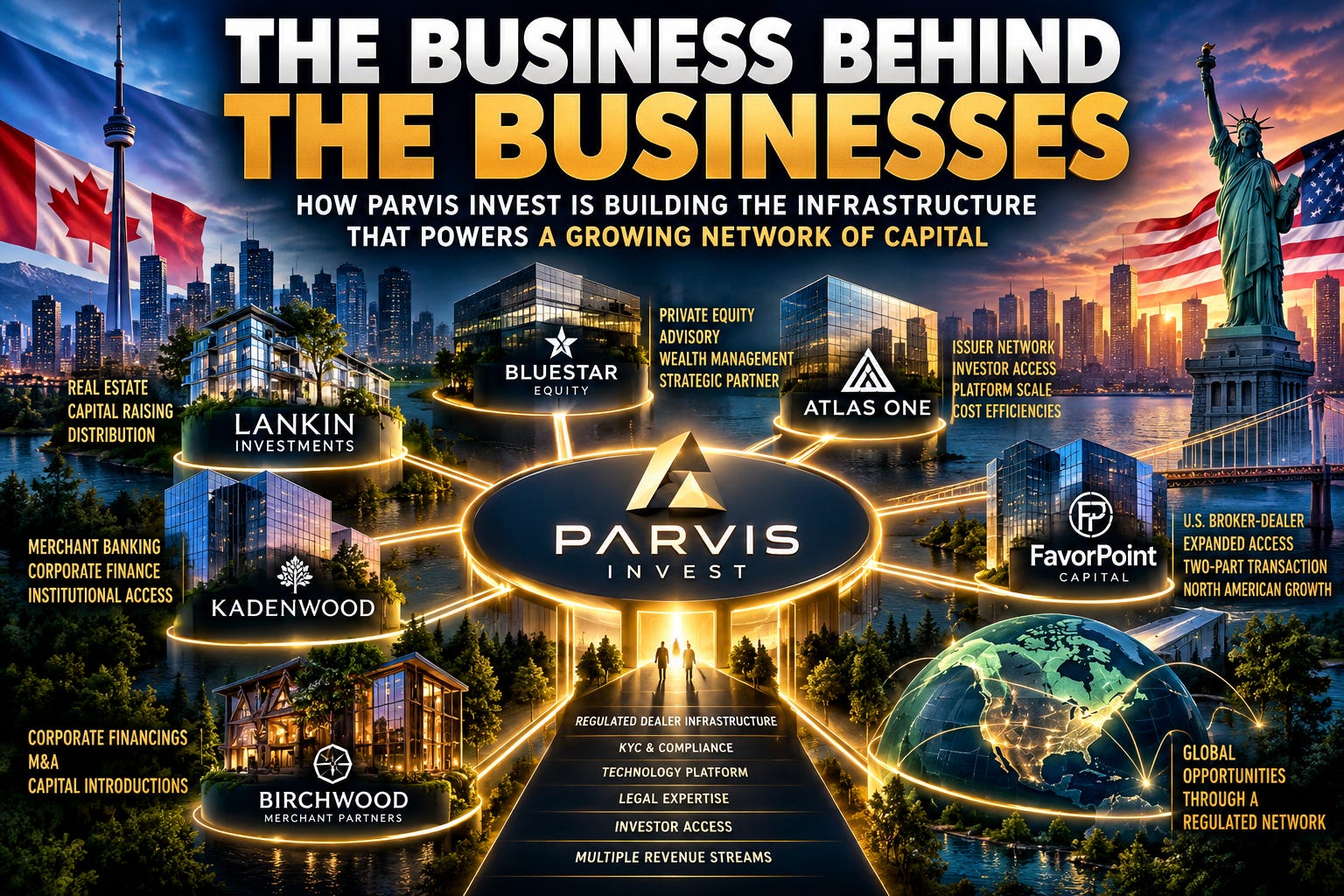
Over the past several days, I’ve spent a considerable amount of time digging into Parvis Invest (TSXV: PVIS), its acquisitions, strategic partnerships, regulatory infrastructure and the people operating within its growing network.
And the more I’ve uncovered, the more my understanding of the company has changed.
Initially, I viewed Parvis as a relatively small Canadian private-investment marketplace. It connected investors with alternative investment opportunities, primarily in real estate, and generated revenue by helping issuers raise capital.
That was a straightforward business to understand.
Then came the acquisitions, the expansion of its issuer network, the strategic investments and the ambitions to enter the United States.
I understood how those developments could make Parvis bigger. What I hadn’t fully appreciated was how they could fundamentally change the way the business grows.
Parvis isn’t simply building a larger investment marketplace. It’s positioning itself as the regulated infrastructure that other businesses can use to raise capital.
And here’s where it gets particularly interesting.
The outside companies may be the real operating leverage.
That one realization changed the way I look at the entire investment thesis.
Understanding what Parvis actually provides
Before connecting the relationships, it’s worth understanding what Parvis has spent years building.
Raising capital in Canada’s private markets isn’t as simple as finding a company that needs money and introducing it to investors.
There are extensive regulatory obligations associated with distributing securities.
Know Your Client (KYC) procedures, anti-money-laundering requirements, investor accreditation, suitability assessments, documentation, compliance supervision, subscription processing, payment administration, reporting and recordkeeping are all part of the process.
Anyone familiar with private-market investing understands just how complicated and time-consuming these requirements can become.
Parvis has invested years developing technology, regulatory systems and operating procedures that streamline these activities.
The company also has an experienced legal and compliance team, with founder and CEO David Michaud bringing a legal and institutional-finance background.
That combination matters.
Many merchant banks, corporate advisers and investment companies are excellent at finding opportunities, sourcing capital and building investor relationships.
But when their activities involve securities transactions requiring dealer registration, they need the appropriate regulatory framework to execute those transactions.
Parvis provides that framework.
Its wholly owned subsidiary, Parvis Investment Services Inc., is registered as an exempt-market dealer across Canada.
But the offering extends beyond dealer registration.
Parvis combines compliance infrastructure, technology, onboarding, investor administration, transaction execution and distribution support within one operating platform.
Instead of building every component independently, businesses can engage Parvis to provide the regulated services their financing activities require.
And Parvis can be compensated for providing those services.
That is the foundation of the opportunity.
Lankin Investments: The example that made everything click
One of the most revealing discoveries came from something as simple as a LinkedIn job advertisement.
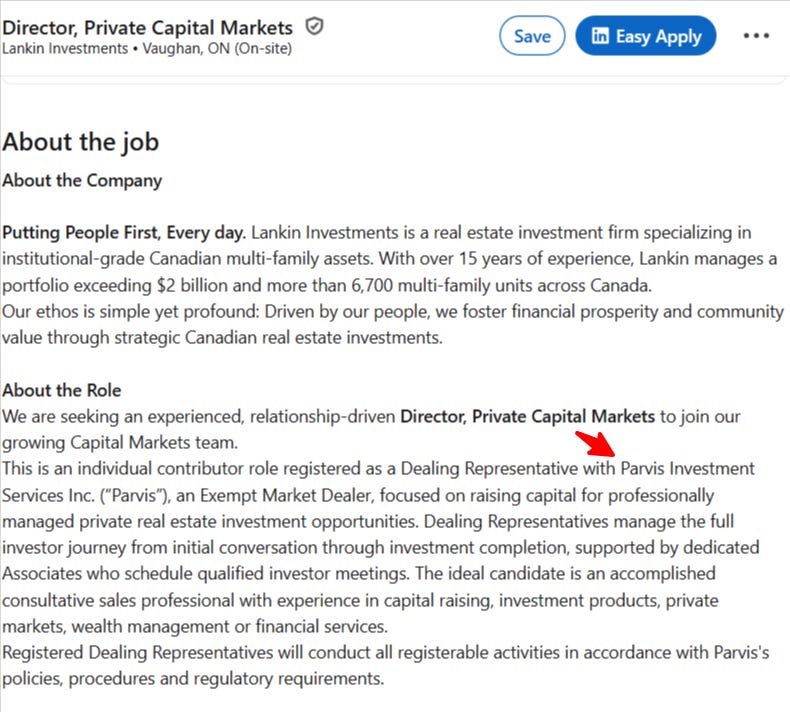
Lankin Investments, a Canadian real-estate investment manager with more than $2 billion in assets, has been recruiting capital-markets professionals.
One posting is for a Director of Private Capital Markets.
The interesting part is how the role is structured.
The individual works for Lankin while being registered as a dealing representative through Parvis Investment Services.
Lankin supplies the investment opportunities, develops investor relationships and builds the team responsible for generating capital.
Parvis supplies the regulated dealer infrastructure and supervises the securities activities performed under its registration.
Now think about what happens as Lankin grows.
If Lankin expands its capital-markets operation and successfully attracts more investment capital through Parvis, transaction volume flowing through the dealer can increase.
Parvis doesn’t necessarily need to hire every additional salesperson or originate every new investment opportunity itself.
Lankin is building an operation that can generate business through the Parvis infrastructure.
And this isn’t simply a casual referral arrangement.
In June 2025, Lankin entered into an exclusive engagement to use Parvis as its exempt-market dealer and technology and compliance platform of record for capital raising.
Lankin also became a strategic investor in PVIS, with its founder and CEO Kyle Pulis joining the Parvis board.
That is a meaningful alignment of interests.
The companies aren’t merely exchanging business cards. They’re building their businesses around a shared commercial relationship.
And the potential is not limited to Lankin.
The discovery that opened my eyes to something much bigger
This is where Dominic Spooner, Kadenwood and Birchwood Merchant Partners enter the picture.
Spooner has spent decades working in capital markets, including investment banking, private placements, corporate financings, merchant banking and institutional capital introductions.
His career includes senior roles and associations with established financial institutions, along with relationships developed across corporate finance and private capital markets.
This is a very different professional background from someone simply joining a brokerage to sell investment products.
We’re talking about an experienced capital-markets operator whose expertise includes helping companies access financing, develop corporate strategies and connect with sophisticated capital providers.
In September 2026, Spooner was approved as a registered dealing representative through Parvis Investment Services. (Under supervision)
But his registration is only one part of the story.
Spooner has connections to Kadenwood Group, a merchant-banking and advisory organization involved in capital raising, mergers and acquisitions, structured financings and institutional relationships.
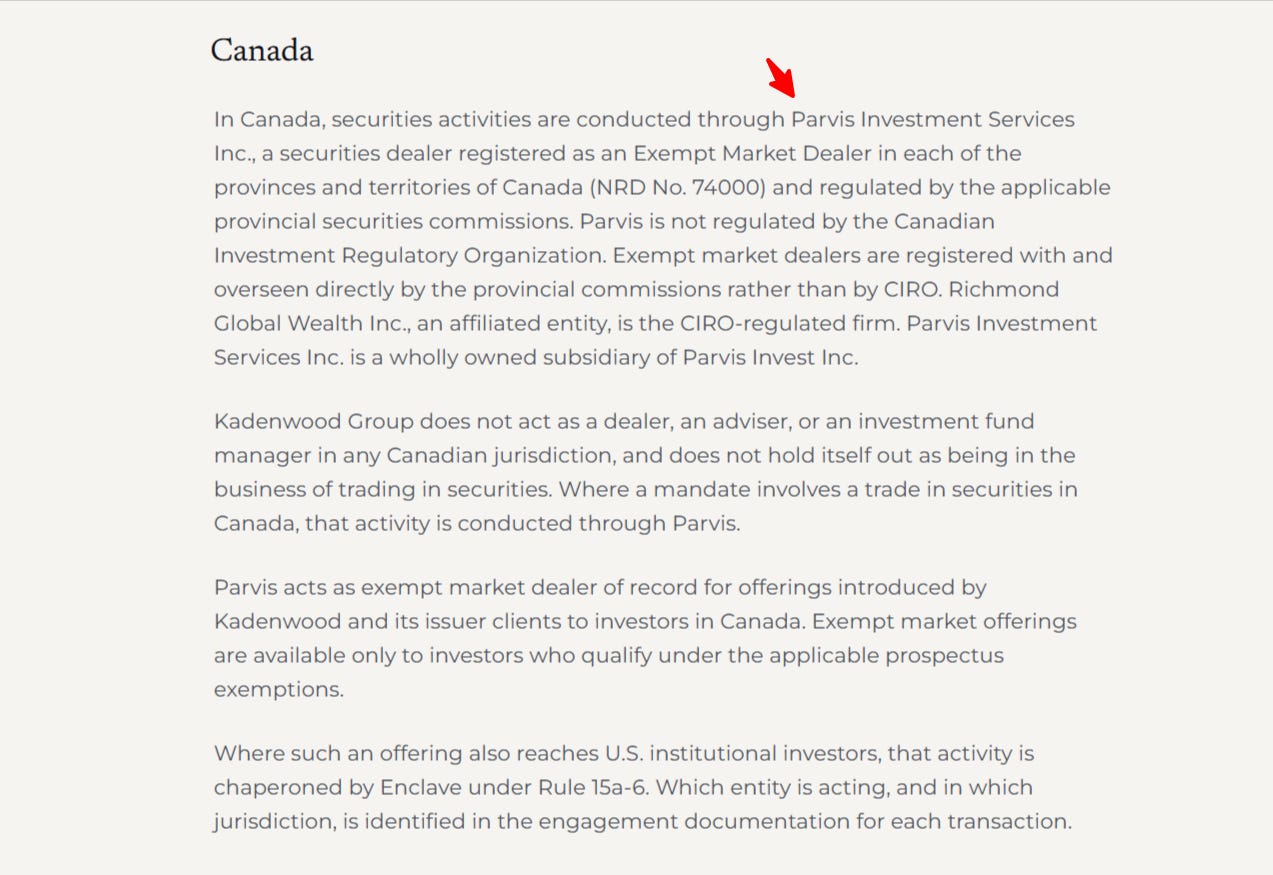
Kadenwood’s publicly available regulatory disclosures identify Parvis Investment Services as its Canadian exempt-market dealer of record for applicable securities transactions.
That’s an important distinction.
Kadenwood can originate corporate financing opportunities and develop relationships with issuers and capital providers.
When those opportunities involve registrable securities activity in Canada, Parvis provides the regulated dealer through which those transactions can be conducted.
Now add Birchwood Merchant Partners.
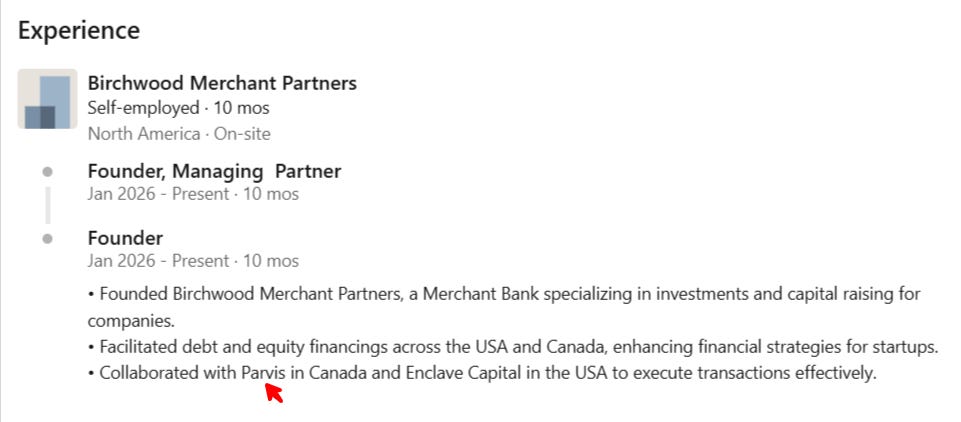
Spooner established Birchwood as a merchant-banking business specializing in investments, corporate finance and capital raising.
His professional description specifically identifies collaboration with Parvis in Canada and Enclave Capital in the United States to execute transactions.
Stop and consider what that represents.
Parvis potentially gains access to established merchant-banking relationships and corporate-financing opportunities without having to acquire an entire merchant bank.
And those opportunities are not limited to real estate.
They can involve growth capital, private equity, corporate financing, acquisition-related securities placements and institutional investment opportunities.
The size and complexity of those transactions can differ substantially from the typical investment products people associate with Parvis.
This is where I started recognizing the broader strategy.
Parvis isn’t necessarily trying to become every type of financial-services business itself.
It’s providing the infrastructure through which different financial-services businesses can conduct eligible transactions.
That’s a very different way to think about growth.
Think about the economics
Here’s a simple example to demonstrate what makes this model interesting.
Imagine several independent businesses collectively originate $50 million in eligible securities placements that are completed through Parvis.
If Parvis retains revenue equivalent to 1% of the capital placed, that represents $500,000.
At 2%, that represents $1 million etc.
These are illustrative figures, not disclosed fee arrangements with Lankin, Kadenwood or Birchwood.
Actual compensation depends on the services provided, the applicable agreements and the allocation of commissions.
But the underlying economics are what matter.
Parvis can potentially earn revenue from transactions generated by independent businesses using its infrastructure.
As those businesses expand, the volume of activity coming through Parvis can increase.
And the company doesn’t necessarily need to expand its own operating costs at the same rate.
That’s operating leverage.
Not simply hiring more people to sell more investments.
It’s creating an infrastructure business that can participate economically in the growth of multiple independent organizations.
Now imagine adding more businesses to that network.
More issuers. More representatives. More investor relationships. More financing mandates.
All potentially generating activity through shared infrastructure.
That’s the part of PVIS I think deserves much more attention.
And the revenue opportunity doesn’t end when capital is raised
Another aspect of Parvis that I believe is underappreciated is the number of ways it can monetize a client relationship.
The company isn’t limited to collecting a commission on a single securities transaction.
Its public disclosures describe several compensation arrangements, including placement commissions, platform fees, onboarding services, marketing, advisory services and certain ongoing fees.
It can also participate in securities syndications alongside other registered dealers.
That means a financing opportunity doesn’t necessarily have to originate inside Parvis for the company to participate in its distribution.
An issuer may require help preparing its investor onboarding process.
Another may need marketing and distribution support.
A corporate-finance transaction may involve a syndicate of multiple dealers.
An existing client may return for an additional capital raise.
The opportunity can extend through multiple stages of a company’s financing activities.
And then there is the Parvis Direct Access Fund.
Parvis operates investment vehicles that provide another potential source of management-fee revenue.
Unlike a one-time placement commission, management fees can continue over the life of an investment arrangement, depending on the fund’s assets and contractual terms.
The company has also identified FundSERV distribution as an intended route for its Direct Access Fund.
That could eventually create another way for financial intermediaries to access Parvis-managed products.
Taken together, these are different opportunities to monetize the same underlying infrastructure.
One issuer relationship can potentially produce more than one revenue event, and one outside distribution partner can potentially introduce more than one issuer.
This is why I don’t think looking exclusively at individual capital raises tells the whole story.
Bluestar: Another piece of the infrastructure network
Bluestar Equity adds another dimension.
In June 2025, Bluestar and Lankin entered strategic investment and commercial relationships with Parvis.
Bluestar’s involvement brings relationships across private equity, capital markets, advisory and wealth management.
The announced collaboration includes M&A advisory, client referrals, fund distribution and services involving Parvis’s regulatory and technology infrastructure.
Again, notice the recurring theme.
One business brings expertise and relationships.
Parvis provides services and distribution capabilities that those relationships can use.
And the relationship can work in both directions.
Bluestar can potentially introduce opportunities to Parvis, while Parvis can support the distribution of eligible Bluestar investment products and facilitate appropriate wealth-related referrals.
The subsequent acquisition of Richmond Global Wealth expands the broader group into wealth advisory services.
This creates another route through which investor relationships and private-market products can potentially intersect.
The larger point is that Parvis is assembling an ecosystem where different businesses contribute different capabilities.
And the platform can benefit from activity across that ecosystem.
Atlas One: More than simply buying another investment platform
This perspective also changes how I look at the acquisition of Atlas One Digital Securities.
Parvis completed the acquisition in August 2026.
On the surface, it was a consolidation of two Canadian private-market platforms.
But there is a more important underlying opportunity.
Atlas brings additional issuers, investor relationships, dealing representatives and operational infrastructure into the combined organization.
Management has indicated that the combined platform serves more than 65 active issuers and a network exceeding 15,000 qualified investors.
Those relationships can potentially support further distribution and cross-selling activity.
At the same time, the acquisition creates an opportunity to eliminate duplicated operating expenses.
Management has targeted approximately $500,000 in annualized cost efficiencies through integration.
Think about what that means.
More business can potentially flow through a combined operating structure, while some of the expenses previously required to operate two separate businesses are eliminated.
That’s the same operating-leverage principle we’ve been discussing, but applied to acquisitions.
Atlas expands the network while potentially making the underlying infrastructure more efficient.
And that’s why I believe the acquisition makes considerably more sense when viewed as part of a broader consolidation strategy.
The U.S. opportunity: FavorPoint isn’t the beginning of the story
Of course, no discussion of PVIS would be complete without addressing its proposed acquisition of FavorPoint Capital.
Parvis announced plans to acquire FavorPoint, a U.S. FINRA-registered broker-dealer, as part of its expansion into American private capital markets.
The acquisition agreement contemplates a two-part process.
First, Parvis would acquire an initial 24.9% minority interest.
Second, it would acquire the remaining 75.1%, subject to the required FINRA approval and other closing conditions.
This structure is worth understanding because the initial minority investment and the subsequent change of control are distinct stages of the transaction.
As of Parvis’s August 26 update, the acquisition remained under TSX Venture Exchange review and subject to the necessary regulatory conditions.
The company also elected not to proceed with additional convertible-debenture financing tranches at that time, indicating that further funding was principally associated with the FavorPoint transaction.
What I find particularly interesting, however, is something we discovered while researching Kadenwood.
Parvis already has a connection to a functioning cross-border capital-markets network.
Kadenwood identifies Parvis as its Canadian exempt-market dealer and Enclave Capital as the U.S. registered broker-dealer used for qualifying institutional transactions under SEC Rule 15a-6.
That means Kadenwood describes an existing structure involving regulated securities activity on both sides of the border.
Parvis handles the Canadian component.
Enclave handles the qualifying U.S. institutional component.
This doesn’t give Parvis ownership of a U.S. broker-dealer, nor does it replace the broader U.S. accredited-investor distribution capabilities contemplated through FavorPoint.
But it demonstrates that the company’s potential participation in cross-border capital raising is not entirely dependent on owning FavorPoint.
And that is an important distinction.
FavorPoint would potentially add direct U.S. ownership and broader distribution capabilities to a Canadian infrastructure business that is already developing international commercial connections.
I view that as meaningful optionality.
The Canadian business can continue expanding through issuer relationships, dealing representatives, strategic partners and Atlas integration while the FavorPoint regulatory process runs its course.
The U.S. acquisition could then add another layer to that network.
And importantly, management’s current FY2027 guidance does not include a contribution from FavorPoint.
That brings us to the financial picture.
Suddenly, the $5 million revenue guidance starts making more sense
Parvis reported fiscal 2026 revenue of approximately $2.32 million, representing 143% year-over-year growth.
Of that total, approximately $1.85 million came from platform fees, representing roughly 80% of annual revenue.
The company also established revenue from advisory and marketing services.
During the same period, general and administrative expenses increased at a significantly slower rate than revenue.
That is an early indication of the operating leverage management has been working toward.
Now consider the company’s FY2027 guidance.
Revenue: $4.9 million to $5.1 million.
Net income: $900,000 to $1.1 million.
And remember, these forecasts exclude FavorPoint.
That’s a considerable step forward from the previous fiscal year.
The first quarter of FY2027 generated approximately $564,000 in revenue, so reaching the annual target requires a substantial increase in quarterly activity through the remainder of the year.
But after examining the business model more closely, I can better understand the different sources from which that growth could come.
Lankin’s external distribution team can potentially generate more eligible transactions through Parvis.
Merchant-banking relationships such as Kadenwood and Birchwood can introduce additional corporate-financing opportunities.
Existing issuers can return for further capital raises.
Platform, advisory, marketing and fund-related services can contribute additional revenue.
Atlas can expand the network while management works toward reducing overlapping costs.
None of these individual relationships needs to account for the entire forecast.
The business model is designed so that multiple independent sources of transaction activity can contribute to the same revenue base.
And that is where the strategy becomes particularly interesting.
The key variable is how much capital those external networks can successfully bring through the platform, what Parvis earns from the related services, and how efficiently the company processes that activity.
This is the operating model that management now needs to demonstrate in its financial results.
The moat isn’t simply the licence
One question I’ve spent a great deal of time examining is what makes Parvis different from other Canadian exempt-market dealers.
Other businesses can provide regulatory dealer services.
Some offer digital investor onboarding, issuer support, representative sponsorship and compliance infrastructure.
So I don’t believe the investment thesis is that Parvis owns something nobody else is legally permitted to build.
The opportunity lies in the combination.
Years of regulatory and technology development.
An established issuer network.
Registered representatives.
Integrated KYC, compliance and subscription systems.
Legal and operational expertise.
Strategic investments and commercial relationships.
Fund-management capabilities.
Wealth advisory exposure.
And a growing network of independent businesses that can potentially generate activity through those systems.
A company like Kadenwood could engage another dealer.
But the value of a relationship extends beyond the existence of a dealer licence.
It can involve regulatory experience, reliable transaction execution, established processes, working relationships and the convenience of having multiple services available through one infrastructure provider.
The more deeply a partner integrates those services into its business, the more valuable that relationship can become.
Parvis’s potential competitive advantage is the network, relationships and operating infrastructure assembled around its registration—not simply the registration itself.
And that network can become more valuable as additional businesses participate.
Why this changes how I value the opportunity
I started this research thinking primarily about the growth of Parvis itself.
How many new issuers will it sign?
How much additional capital will it raise?
How many representatives will it recruit?
What will Atlas contribute?
Will FavorPoint close?
Those are still important questions.
But now I’m looking at something else.
How much can Parvis grow as the businesses operating through it grow?
That’s the variable that could make this a much more scalable operation than I originally appreciated.
Lankin can expand its capital-markets team.
Kadenwood can originate more financing mandates.
Birchwood can establish additional corporate relationships.
Bluestar can introduce more advisory and investment opportunities.
Atlas can contribute additional issuers, investors and distribution capacity.
And those activities can potentially generate eligible transactions and service revenue for Parvis.
The company does not need to own every partner to benefit commercially from that activity.
It doesn’t need to acquire every merchant bank.
It doesn’t need to originate every private placement.
And it doesn’t necessarily need to fund the full expansion of every sales team producing transactions through its infrastructure.
The growth of independent businesses can become a growth driver for PVIS.
To me, that’s the most interesting aspect of the investment thesis.
The part I think investors are overlooking
I believe many investors still see PVIS primarily as a small real-estate Sass investment platform attempting to grow through acquisitions.
I understand why.
That’s where the company started, and it’s still how much of its business is described publicly.
But after examining the regulatory disclosures, strategic relationships, hiring advertisements, acquisition strategy and the background of people entering its distribution network, I believe there’s a much broader picture emerging.
This is potentially an infrastructure and distribution business serving a fragmented private-capital industry.
And private capital raising isn’t limited to real estate.
It includes corporate growth financings, alternative investment funds, private credit securities, acquisition-related capital raises and other exempt-market opportunities.
Different businesses specialize in different areas.
Parvis is positioning itself to provide regulated infrastructure and services across those activities.
The opportunity isn’t that every one of those businesses becomes a Parvis subsidiary.
It’s that some of their financing activity can be conducted through Parvis.
I think that is an important distinction for shareholders to understand.
Especially at a stage when management is forecasting a meaningful improvement in revenue and profitability.
The relationships and infrastructure help explain how the business is intended to operate.
The financial results will tell us how effectively that strategy is translating into earnings.
Final thoughts
The more I’ve researched PVIS, the more I realize this is not simply a story about a small investment marketplace becoming a larger investment marketplace.
It’s about potentially building a central operating platform for multiple independent capital-raising businesses.
Lankin demonstrates how an outside organization can build distribution capacity through Parvis.
Spooner, Kadenwood and Birchwood demonstrate how established merchant-banking networks can connect corporate-financing activity with Parvis’s Canadian dealer infrastructure.
Bluestar and Richmond expand the broader wealth and advisory ecosystem.
Atlas brings consolidation, relationships and potential cost efficiencies.
FavorPoint could eventually add direct U.S. broker-dealer ownership and broader American distribution capabilities.
And the Direct Access Fund and additional service lines introduce further ways of monetizing relationships over time.
Individually, these developments are interesting.
Together, they begin to reveal what management may actually be building.
A platform where outside businesses bring financing opportunities and investor relationships, Parvis provides the regulated infrastructure, and eligible transactions generate revenue through a shared operating structure.
The company has already demonstrated revenue growth. Management’s FY2027 guidance now sets a much higher target for the next stage.
What interests me most is that the model has the potential to allow revenue to expand faster than operating costs.
And the greatest source of that leverage may not be found on Parvis’s own payroll.
It may be found in the independent businesses growing around it.
That’s the part of PVIS I didn’t fully appreciate before this research.
And it’s the part I believe deserves far more attention.
The Stock Avengers
Independent research and commentary. This article reflects my interpretation of publicly disclosed relationships, financial results and business strategy as of October 20, 2026. Illustrative fee examples are not company guidance. The proposed FavorPoint acquisition remains subject to its closing conditions. Nothing in this article constitutes investment advice.