

Research dated November 14, 2026. Financial statement amounts are US dollars unless explicitly labelled C$. Share prices and October financing terms are Canadian dollars.
NowVertical has given shareholders plenty of reasons to stop paying attention. Acquisitions failed to produce the integration benefits originally promised. Leadership changed repeatedly. Receivables absorbed cash, financing obligations crowded the balance sheet, and every apparent recovery came with another reason to question its durability.
Then Kingsley Ward arrived with capital and an executive chair role.

For investors familiar with DATA Communications Management and the transition from Simply Better Brands into TRUBAR, that deserves attention. The question is whether NOW has a worthwhile operating business trapped inside an inefficient financial structure, and whether the new leadership can unlock enough value for common shareholders after debt, financing costs and dilution.
My assessment is that a credible turnaround opportunity exists. The evidence supports a place on a serious 2027 watchlist. It does not yet support treating the turnaround as proven or awarding it top pick status simply because Ward is involved.
There is a business here. There is also a substantial difference between reported adjusted EBITDA and cash available to shareholders.
How bad did it get?
Price history shows NOW trading as high as C$1.43 in November 2021, reaching C$0.08 in November 2024, recovering to C$0.70 in May 2025 and returning to C$0.09 during July and August 2026. These observations describe successive trading extremes, rather than an investor’s realized return. From the 2021 high to the 2024 low, the quoted decline was approximately 94%. From the 2025 high to the 2026 low, it was approximately 87%.
At C$0.20, the stock has already more than doubled from the 2026 low. Investors evaluating it today are buying after an initial recovery, even though it remains deeply depressed relative to older prices. Those older prices provide context, not a valuation target.
The operating history explains the damage. In January 2024, NOW’s own board said acquisition integration had fallen short and that its spending trajectory was unsustainable without substantial dilution on potentially punitive terms. That is unusually direct acknowledgement of what had gone wrong. January 2024 reorganization
The leadership sequence matters:
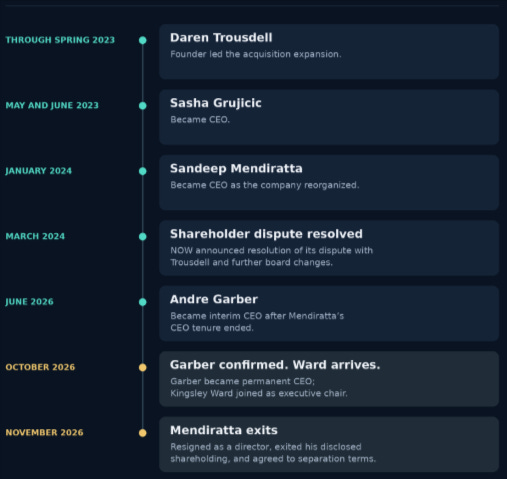
Sources: 2023 CEO appointment, 2024 dispute resolution, June 2026 transition, October CEO appointment, board appointments.
Garber is a cofounder who previously led acquisition and financing programs. His institutional knowledge is useful, but this is not an entirely external management reset. Investors should expect the new team to demonstrate a different allocation discipline rather than assume a clean break with the past.
Why Ward’s involvement matters
Ward has chaired DCM since 2016. At Simply Better Brands, he became chairman and interim CEO in February 2024 when Kathy Casey resigned. The company subsequently exited its CBD businesses and concentrated on TRUBAR, formally adopting the TRUBAR name in May 2025. Ward transitioned to executive chairman while Erica Groussman took responsibility as CEO.
The relevant precedent is simplification: identify the valuable business, remove distractions and financing pressure, and pair capital markets experience with operational leadership. Ward did not achieve those changes alone, and a consumer brand turnaround does not establish that he can reproduce the result in global data services. DCM biography, SBBC leadership change, CBD exit update, TRUBAR reorganization
For our community, the SBBC history provides a familiar reason to investigate. The concern about historical PureKana marketing spending also appears in the supplied November 2024 FINS review. That is historical investor criticism, not independent proof that one executive personally caused the company’s difficulties. The NOW thesis can stand without making that allegation.
The outgoing CEO sold. What actually happened?
Mendiratta and a joint actor disposed of 11,276,919 shares at C$0.15, leaving their disclosed shareholding at zero:
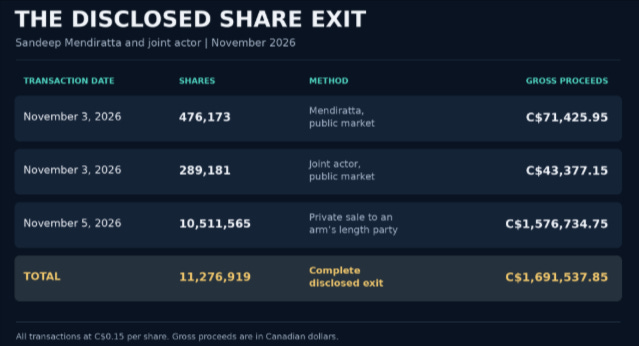
Most of the disposal was a private block. Describing the entire exit as shares dumped into ordinary market trading would misrepresent the disclosure. The release says the seller made an investment decision to cease holding the securities. It does not identify the private purchaser. There is no verified basis here to say Ward bought that block. Seller’s early warning release
Separately, NOW agreed to a £405,000 separation payment to Mendiratta in exchange for a full and final release. That corporate payment and the proceeds from selling his shares are different transactions. The release does not establish whether this payment was wholly included in previously recorded severance expenses, so it should not automatically be added to those expenses a second time. November 6 separation announcement
A former CEO choosing to retain no shares is relevant. His motivation beyond the stated investment decision remains unknown. The stronger conclusion is that the ownership and leadership transition is substantial, not that the sale proves either collapse or recovery.
Ward’s capital: meaningful commitment, different economics
Ward’s October early warning release discloses a C$3.28 million subscription for convertible debenture units, directly and indirectly. Following the transaction, his disclosed position comprised:
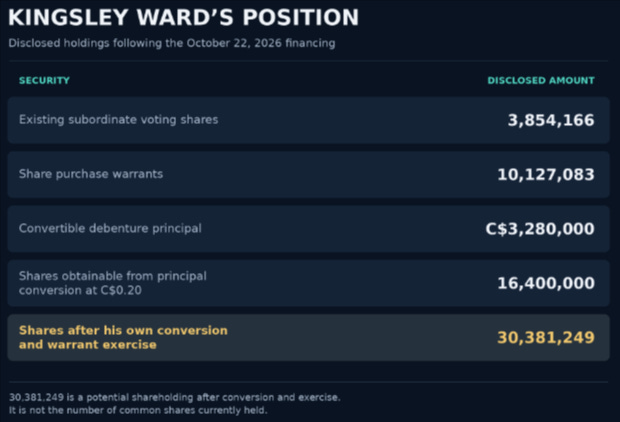
The release states 2.77% ownership of outstanding subordinate voting shares and 18.33% on its specified partially diluted basis. That latter percentage assumes his securities convert and exercise. It is not his current common share ownership, nor a fully diluted percentage assuming everyone else’s securities are exercised. Ward’s early warning release
The debentures pay 10%, mature in October 2029 and convert at C$0.20. Associated warrants exercise at C$0.25. This gives Ward a contractual interest claim and potential equity participation. He bears meaningful credit risk, but his financing package has different economics and priority from someone buying only common shares at C$0.20.
SEDI also records 190,000 shares acquired in the public market on November 12 at C$0.20, under Ward’s report with Christine Ward as registered holder. That is C$38,000 of additional common share exposure. It should be described precisely, rather than presented as a multimillion dollar personal open market purchase by Ward.
The alignment is real. The structure matters just as much as the headline investment amount.
Balance sheet health: improving liquidity, limited tangible protection
The September balance sheet predates the October financing.
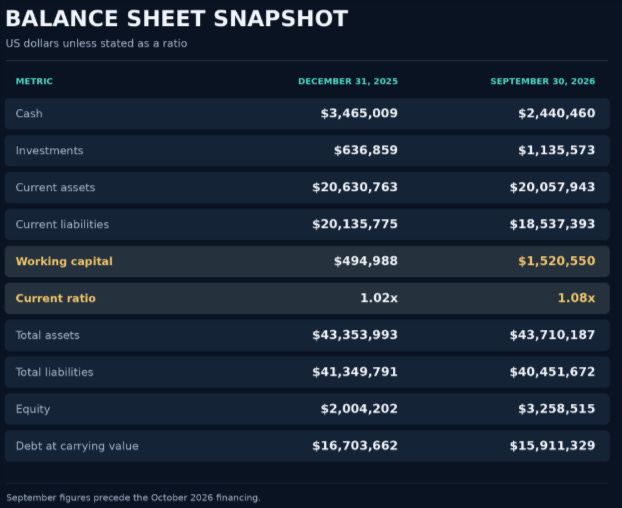
Source: Q3 financial statements, statement of financial position and Note 12. Ratios and working capital are calculated from the reported figures.
The improvement deserves recognition. For context, the December 2024 balance sheet had approximately $9.7 million of negative working capital. But the current ratio alone overstates how comfortable liquidity feels when cash is only $2.44 million against $18.54 million of current liabilities.
The earnings release describes approximately $3.6 million of cash and cash equivalents. That figure reconciles approximately to cash plus the separately classified investments. For analysis, I retain those categories separately rather than assume the entire amount is immediately available bank cash.
Total assets cover total liabilities by just 1.08x. Assets cover recorded debt by 2.75x, but that second ratio excludes the many other claims on those assets. Recorded debt to equity is 4.88x.
More importantly, goodwill is $12.25 million and intangible assets are $6.93 million. Together they represent approximately 44% of assets. Removing both from equity produces negative tangible equity of about $15.92 million. This is a cash generation thesis with limited tangible balance sheet protection.
The current and noncurrent balances labelled “subscription and other receivables” total $11.12 million, up from $8.14 million at year end. The annual statements called those comparative balances unbilled receivables, and the cash flow note continues to use that description. This presentation needs explanation. These amounts should not be interpreted as evidence of contracted subscription revenue or money owed by investors subscribing for shares.
Goodwill, intangibles and that receivable category together account for approximately 69% of assets. Collection timing and the economics of the acquired businesses matter far more than the headline asset total.
October financing: breathing room with a price
NOW raised C$15.1 million gross:
Component Terms C$5.1 million equity units 42.5 million shares at C$0.12, with half a warrant per unit Equity unit warrants 21.25 million shares at C$0.20, expiring after 24 months C$10 million convertible debt 10% coupon, conversion at C$0.20, maturity after 36 months Debenture warrants 25 million shares at C$0.25, expiring after 36 months
Sources: October 20 closing, October 22 closing.
The MD&A reports $12.8 million of cash as of its preparation date, including $1.9 million held at banks in Argentina. That is a much more useful postfinancing liquidity disclosure than mechanically adding the gross raise to September cash. The geographic location does not establish that the cash is restricted, but transferability and availability for parent company obligations warrant clarification.
The financing does not mean debt has disappeared. It adds C$1 million of annual contractual interest. NOW can pay that interest in shares under the disclosed terms, which substitutes dilution for cash outflow.
Existing contractual loan principal was approximately $16.82 million at September end, compared with a $15.91 million accounting carrying value after issuance cost adjustments and other differences. The $12 million revolving facility comes due in May 2028, with extension subject to lender consent. The scheduled 2028 principal repayments total approximately $13.31 million. The company reports covenant compliance at September 30; it does not disclose the financial cushion before a breach. The possible $8 million accordion is subject to approval and should not be counted as cash already available. Financial statements, Note 12; MD&A, liquidity section
A new equity raise appears less urgent following the October financing. A categorical claim that NOW will not need more capital would still be premature.
Cash flow: the central test
Nine months ended September 30, US dollars 2025-2026 Operating cash flow ($4,749,862) $376,308 Purchases of property and equipment $67,023$88,842 Investment in intangible assets $460,596$346,499 OCF less those two investment categories ($5,277,481) ($59,033) Adjusted EBITDA$5,399,755 $5,089,231
Sources: cash flow statement and Note 17, MD&A adjusted EBITDA reconciliation. The OCF less investment row is an analyst calculation, not management’s defined free cash flow measure.
The turnaround in operating cash flow is substantial. However, cash conversion is only 7.4% of adjusted EBITDA, and the business remained slightly negative after equipment and intangible investment. That calculation precedes acquisition consideration payments and debt principal repayments.
The working capital detail is revealing. Unbilled receivables absorbed $2.98 million. Accrued expenses and other current liabilities supplied $3.08 million. Trade and other receivable movements supplied $454,000, while accounts payable consumed $930,000.
It would be inaccurate to say every creditor balance increased. Accounts payable actually declined. But the larger accrued liability balance provided important financing to the operating cash flow result. Holding every other line unchanged, removing that $3.08 million contribution would leave approximately $2.71 million of operating cash outflow. That is a sensitivity calculation, not a claim that all accrued liabilities are overdue or that this is the company’s normalized burn rate.
The right question for 2027 is whether customers can fund the business through collections, without continued reliance on rising accruals or another financing transaction.
Profitability: progress, with weaker margins
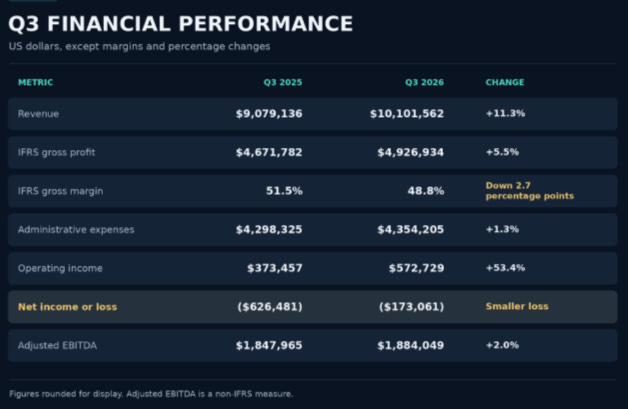
Sources: Q3 statements, Q3 MD&A.
Revenue grew faster than overhead, producing genuine operating leverage. Gross margin weakened, however, so this is not simultaneous improvement across revenue, margins and expenses.
The quarter also includes a $398,883 gain from derecognizing acquisition consideration. Reported pretax income was $325,699. Without that gain, and holding other items unchanged, pretax performance would have been a loss of approximately $73,000. Net profitability still needs work.
The $1.88 million adjusted EBITDA includes an $805,072 adjustment labelled the impact of cost synergies related to employee reductions. The discussion links this area to severance, especially the CEO transition. Reconciliation is appropriate, but investors need to distinguish costs already incurred from savings projected or realized. Excluding that particular adjustment, adjusted EBITDA would be approximately $1.08 million for the quarter.
The cost comparison also needs consistent treatment. Excluding severance alone, management reports a 14% decline in administrative expenses. But share compensation also fell from $676,386 to a small recovery. Excluding both the severance adjustment and share compensation from both periods, administrative expenses were approximately $3.55 million versus $3.45 million, an increase of about 3%. The underlying cost picture is less dramatic than a single exclusion suggests.
The geographic detail changes the growth story
Q3 revenue, US dollars 2025-2026 Change Argentina $2,743,492 $4,541,793 +65.5% All other countries combined $6,335,644$5,559,769 (12.2%) Consolidated $9,079,136 $10,101,562 +11.3%
Argentina contributed approximately $1.80 million of growth against only $1.02 million of consolidated growth. It therefore accounted for more than all of the net increase. For the nine months, revenue outside Argentina declined approximately 4.5%.
Brazil’s Q3 revenue fell approximately 31%, UK revenue fell 6%, and US revenue fell 79%, although the US contribution is relatively small. The “other countries” category grew strongly. These are reported dollar comparisons by customer domicile, not constant currency growth measurements. Argentina’s IAS 29 hyperinflation accounting also complicates interpretation. Financial statements, Note 7; MD&A currency discussion
The implication is specific: the recovery has not yet broadened across the geographic revenue base. It would also be wrong to assume Argentina’s entire increase is an accounting artifact. The filings do not provide the constant currency bridge needed to separate volume, pricing, inflation and exchange effects cleanly.
What is worth owning inside NOW?
The assets that matter economically are client relationships, skilled delivery teams, delivery methods and technology partnerships.
Core data analytics solutions and services revenue grew approximately 19.6% to $8.82 million in Q3. Google Cloud related revenue rose approximately 108% to $2.69 million. Google related revenue overlaps the existing service and resale categories; it is not incremental revenue to add on top of them.
Top 30 account revenue increased approximately 25% to $8.48 million, or 83.9% of the total. One customer represented approximately 10.8%. Concentration among 30 accounts is different from dependence on a single customer, but it makes retention and expansion within those relationships central to the thesis. Most clients do not sign multiyear contracts, according to the MD&A. Long tenure supports repeat business, but does not justify applying a contracted subscription software valuation. MD&A, business metrics and growth strategy
The operations segment generated $2.72 million of adjusted EBITDA in Q3. Corporate costs consumed $835,000, up from $522,000 a year earlier. Through nine months, operations generated $7.63 million while corporate costs consumed $2.54 million. That suggests a potentially valuable operating base and a concrete area for Ward to examine. Those segment measures remain adjusted figures, not distributable cash.
Additional asset proceeds provide modest help. Management expects net Allegient earnout proceeds of approximately $600,000 in 2027 and $500,000 in 2028. These are estimates dependent on collection and related payout obligations, not recurring operating earnings. The winding down Chilean and Mexican disposal group still has approximately $1.56 million more current liabilities than current assets. Simplification can release value, but can also require settlement cash. MD&A dispositions; financial statements Note 21
Share capital and valuation: the old price is not the old ownership claim
September share equivalents were 99,089,165. Adding October’s 42.5 million shares produces approximately 141.59 million equivalent shares, including the conversion equivalent of proportionate voting shares. Subordinate voting shares alone would be approximately 139.21 million. This distinction reconciles much of the difference between the financial statement count and the denominator used in the early warning releases.
The October equity issuance increased the equivalent share count by approximately 42.9%. In addition, the financing creates:
Potential additional shares Amount Convertible principal at C$0.2050,000,000Equity unit warrants at C$0.2021,250,000 Debenture warrants at C$0.2525,000,000 Total from those instruments 96,250,000
That would take the equivalent count to approximately 237.84 million, before broker securities, options, RSUs, PSUs or shares issued for interest. It is a scenario, not the current basic share count. Debt conversion removes the corresponding debt claim, while cash warrant exercises would bring in C$10.5 million. A valuation must recognize those benefits alongside dilution rather than add shares and leave the converted debt unchanged.
At C$0.20 and approximately 141.59 million equivalents, indicative equity value is C$28.32 million. For scale only, using an explicitly illustrative exchange rate of C$1.40 per US$1, September contractual loan principal, the new C$10 million debenture and the MD&A’s later $12.8 million cash disclosure yields indicative net debt of C$15.63 million and enterprise value of C$43.95 million. This mixes reported dates and assumes no intervening loan repayments; it is not a verified current enterprise value.
At that illustrative enterprise value, annualizing nine month adjusted EBITDA gives approximately 4.6x. Annualizing operating income plus depreciation and amortization, without the other adjustments, gives approximately 6.9x. Neither is a forecast or a TTM multiple. The gap illustrates how much the apparent bargain depends on the earnings definition. Financial statements and share capital notes, MD&A
Before publishing a precise target price, the capitalization needs confirmation. The MD&A’s share data appears to omit October’s financing despite describing it elsewhere. Note 24 reports C$495,875 of commissions and 2,301,833 broker warrants, while the two closing releases disclose cash commissions totaling C$400,875 and the first release lists 1,193,500 broker warrants. Additional fees or securities may explain the differences, but the reviewed documents do not reconcile them.
What would make NOW a credible 2027 top pick?
The opportunity is straightforward. If growth broadens beyond Argentina, collections improve, temporary transition costs disappear and corporate overhead becomes more efficient, the existing operating base could produce substantially more cash. Ward’s network, financing experience and willingness to invest improve the credibility of that path.
The failure case is equally straightforward. Adjusted EBITDA stays positive while unbilled receivables and accruals grow. The company pays interest in shares, spends the financing proceeds without improving cash conversion and approaches the 2028 bank maturity needing another recapitalization. The business survives, but existing common shareholders receive a smaller portion of the eventual upside.
My promotion criteria would be:
Two consecutive quarters of positive operating cash flow after equipment and intangible investment, with working capital contributions explained.
Unbilled receivable growth slowing below revenue growth, with improved disclosure on billing milestones, aging and subsequent collections.
A credible reconciliation of the share count, financing fees and all potential dilution.
Stabilization or growth outside Argentina, supported by constant currency disclosure.
Reduced transition adjustments and better corporate cost absorption.
A clear plan for bank debt reduction or refinancing before the May 2028 maturity.
These are analytical thresholds, not company guidance. They distinguish evidence of a recovery from confidence in the people attempting it.
FINS FACTS
Q3 revenue increased 11.3% to US$10.10 million; IFRS gross margin fell to 48.8%.
Argentina grew 65.5%; revenue outside Argentina declined 12.2%.
Q3 operating income increased to US$572,729, but net loss remained US$173,061.
Nine month adjusted EBITDA was US$5.09 million; operating cash flow was US$376,308.
Operating cash flow less equipment and intangible investment was negative US$59,033.
September assets were US$43.71 million against US$40.45 million of liabilities; tangible equity was approximately negative US$15.92 million.
October raised C$15.1 million gross, including C$10 million of 10% convertible debt. Later disclosed cash was US$12.8 million.
Ward invested C$3.28 million in convertible debenture units. A separate C$38,000 public market purchase was reported with Christine Ward as registered holder.
Mendiratta and a joint actor exited 11.28 million shares, predominantly through a private sale to an unidentified arm’s length buyer.
Assessment: a credible but financially unproven turnaround candidate for 2027. Top pick status requires cash conversion, broader growth and a reconciled capital structure.
Research basis and publication notes
The analysis uses the full Q3 2026 financial statements and MD&A, the 2025 annual financial statements, issuer announcements, early warning releases, SEDI transactions and through price observations. No investment position, compensation status or personal trading activity has been granted the author.
Additional annual source: 2025 audited financial statements.