

Some investments fail because the underlying asset was never real.
Boosh Plant Based Brands was different.
Buried inside a crappy vegan stock trading for pennies was Beanfields, an established snack brand that had once generated approximately US$15 million in annual sales and had been carried in roughly 7,000 stores across North America.
That was precisely what made VEGI interesting.
That’s also what made the eventual dumpster fire so painful
WHY WE BOUGHT VEGI
TSA began buying VEGI around $0.02 in February 2023.
At that price, the market appeared to be treating Boosh as though almost nothing inside the company had value. Our thesis was that Beanfields alone could make that assumption wrong.
Boosh had acquired substantially all of the Beanfields assets in 2022. The company later described the purchase consideration as eight million Boosh shares, US$1 million of operating capital and a US$400,000 loan.
Management said Beanfields had produced approximately US$15 million in sales before the pandemic. Boosh also reported that Beanfields had historically reached thousands of retail locations and international markets.
That is an important distinction. The public disclosure supported approximately US$14.5 million in trailing revenue, not an independently appraised $14 million asset value.
The company had some debt but it was not a shell company trying to invent a product. It owned a recognizable consumer brand that had already demonstrated demand.
The opportunity appeared straightforward. Get the chips manufactured (3rd party) Improve, work on Margins, Get them back onto shelves. Stabilize distribution. Finance the working capital cycle. Let the existing brand do the heavy lifting.
At this time, there were multiple customers and companies asking about getting the chips back on the shelf.
At two cents, we did not need perfection. We needed basic corporate execution.
THE TRADE WORKED BEFORE THE INVESTMENT FAILED
The history needs to be told honestly.
VEGI was not an immediate loss for everyone.
The TSA trade log shows community purchases around $0.02 in February 2023. It also records trims between approximately $0.08 and $0.09, including members reporting substantial gains.
The stock produced a genuine multibagger move.
That matters because this was not a fabricated thesis attached to an assetless promotion. The market briefly recognized the possibility that Beanfields could be revived.
The mistake came later.
Some of us took profits and then returned. Others continued averaging down as the share price deteriorated. We remained focused on what Beanfields had been worth historically while the evidence increasingly showed that Boosh could not reliably fund, operate or report on the business.
We confused the potential of the asset with the capability of the company controlling it.
THE CAPITAL PROBLEM BECAME THE OPERATING PROBLEM
Consumer packaged goods businesses consume working capital and healthy margins.
Products must be manufactured before they are sold. Packaging, ingredients, freight, warehousing and retailer payment cycles all require cash. A brand can have demand and still collapse if the company cannot finance inventory.
Boosh acknowledged these pressures.
In early 2023, it completed a private placement that ultimately raised approximately C$362,000. It also announced multiple shares for debt transactions as creditors were paid with equity instead of cash.
The company issued millions of shares to settle obligations. Those transactions may have preserved liquidity, but they also demonstrated how constrained the balance sheet had become.
The problem was no longer simply getting Beanfields back into stores.
The company was settling creditors, borrowing to maintain public filings and looking for ways to continue operating.
Management announced partnerships, advisers and licensing arrangements. Each announcement offered another possible bridge to recovery.
But a bridge is only useful when it reaches the other side.
THE FILING FAILURES CHANGED EVERYTHING
Delayed financial statements were not an administrative footnote.
They were a warning that investors could no longer reliably measure the company’s condition.
Boosh received management cease trade orders related to late filings in both 2022 and 2023. The company later faced a broader cease trade order, and the Canadian Securities Exchange currently lists VEGI as suspended.
Once a company cannot produce current financial statements, the entire investment changes.
Investors cannot confidently determine what the company owns, what it owes, how much revenue is being recognized, how much cash remains or whether announced commercial activity is translating into shareholder economics.
At that point, the absence of reliable reporting becomes part of the operating thesis.
THE BEANFIELDS STRATEGY KEPT CHANGING
In August 2023, Boosh announced an exclusive United States licensing arrangement with Simple Yummy Chips. Boosh was to receive a royalty equal to seven per cent of the licensee’s cost of goods sold, subject to minimum sales targets.
The company also announced a line of credit of up to US$1 million for Beautiful Beanfields, carrying interest at 15 per cent annually.
Management presented this structure as a way to satisfy American demand without requiring Boosh to supply all the capital and resources itself.
Less than a year later, the strategy changed again.
In May 2024, Boosh and Simple Yummy Chips entered a nonbinding letter of intent contemplating the sale of the Beautiful Beanfields brand. Interim CEO Robert Hall said the potential divestment could reduce liabilities by approximately US$2 million and reduce the company’s capital burden.
That announcement revealed the central contradiction.
Beanfields was the asset that made the company interesting, but Boosh’s financial position made that same asset increasingly difficult to support.
WHERE MANAGEMENT LOST THE COMMUNITY
Shareholders can tolerate bad quarters.
They can tolerate difficult financings, imperfect launches and delays that are clearly explained.
What they cannot tolerate indefinitely is a widening gap between promises and execution.
Inside the TSA community, frustration became humour because humour was easier than repeatedly confronting the same disappointment.
Shareholders joked about product photographs, outdated samples, missed timelines and whether another announcement would ever produce something tangible. A remembered comment about Sundays being reserved for family became shorthand for what investors perceived as a lack of urgency.
Repeated capital constraints, extensive equity issuance, delayed filings, management changes, strategic pivots and an eventual trading suspension.
Our conclusion was not that Beanfields lacked potential.
It was that Boosh failed to convert that potential into a functioning, adequately financed and reliably reporting public company.
Connie Marples was the company’s founder and served as CEO during much of this period. She stepped down as CEO and director in April 2024, remained an adviser and was subsequently identified again as CEO in later company announcements.
Leadership changed. The fundamental questions did not.
THE COMPANY IS STILL ATTEMPTING A REVIVAL
The story has not technically ended.
In May 2026, Boosh said it had engaged an accounting firm to complete preaudit work and intended to file its outstanding fiscal 2024, 2025 and 2026 statements concurrently.
The company also reported that its American licensee, Tahoe Nutrition LLC, had processed approximately US$2.18 million in gross orders through a summer food program.
Processed orders should not automatically be treated as recognized Boosh revenue.
Boosh subsequently signed a nonbinding letter of intent to acquire Tahoe. The proposed consideration would leave the vendor holding approximately 50 per cent of Boosh’s fully diluted shares. Completion remains subject to due diligence, definitive documentation, regulatory and shareholder approvals, revocation of the cease trade order and resumption of trading.
That may eventually produce a viable recapitalization.
It may also produce substantial dilution for existing shareholders.
Until the audits are filed, the cease trade order is revoked and definitive agreements replace letters of intent, it remains a proposed rescue rather than a completed recovery.
THE REAL LESSON
The lesson from VEGI is not that distressed stocks should never be purchased.
At approximately two cents, the original setup offered a genuine asymmetric trade. Some investors successfully captured that move.
The lesson is that an asset thesis must eventually become an execution thesis.
A valuable brand cannot finance itself.
Historical revenue cannot manufacture current inventory.
Distribution history cannot replace working capital.
Press releases cannot replace audited statements.
And a recognizable product cannot protect shareholders from a company that loses control of its capital structure and reporting obligations.
We were right that Beanfields had value.
We were wrong to believe that value alone was enough.
Check the balance sheet, history of the team and remember CPG is capital intensive Regardless of whether you have third party fulfillment, the margins of a product mean more than the doors.
It’s better to have a thousand doors at a healthy margin versus 10,000 doors and burning cash.
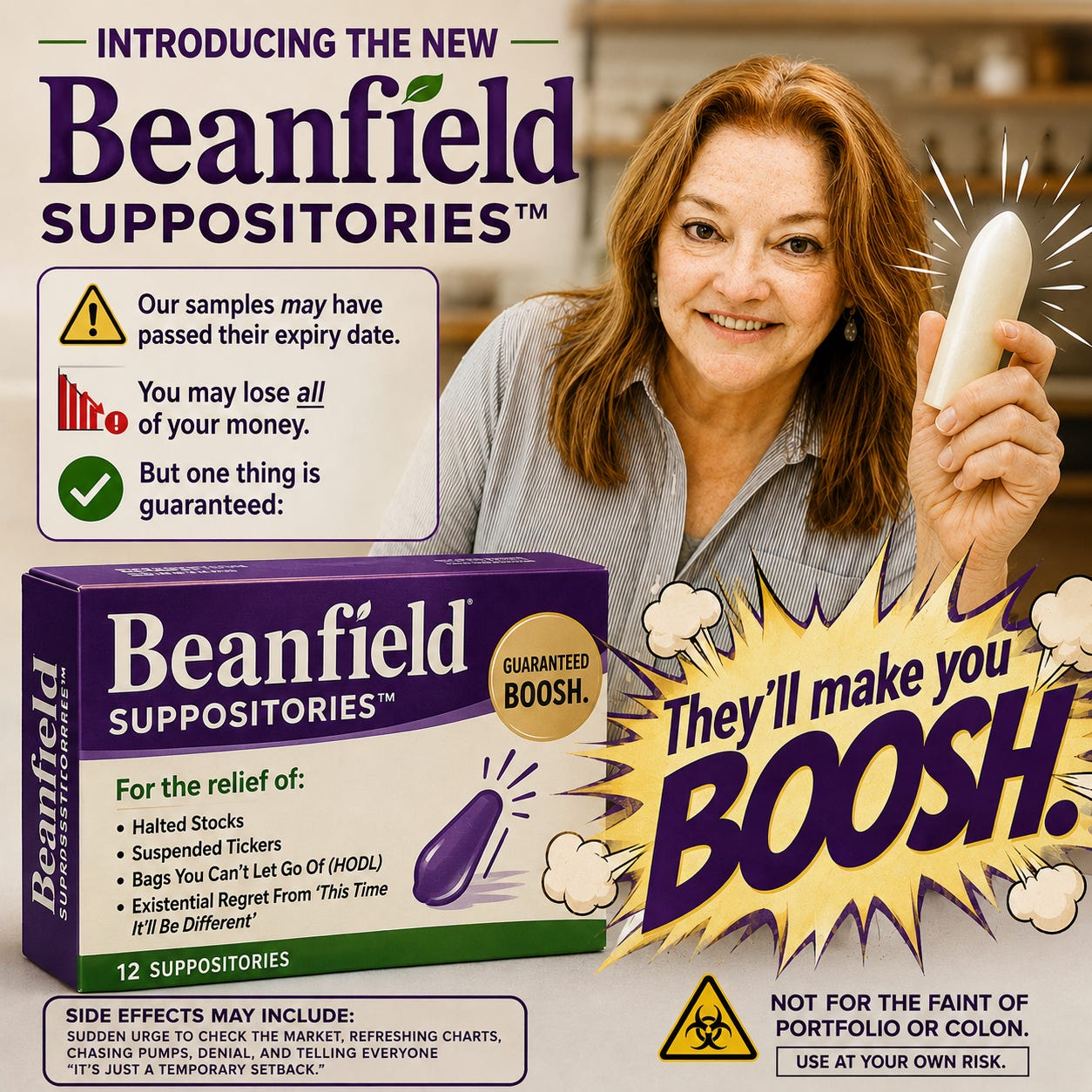
AND NOW, A MESSAGE FROM THE PRODUCT DEVELOPMENT DEPARTMENT
This article would not be a proper VEGI autopsy without acknowledging the coping mechanism that got shareholders through it: satire.
Time For the Pivot, Beanfields Suppositories.
Possible side effects may include regret, confusion, sudden urges to check CEO.CA and the realization that a recognizable brand is not the same thing as a functioning public company.
.