

If you’re on this list, you already know the HBFG story.
You know HEAL.
Thanks for reading! Subscribe for free to receive new posts and support my work.
You know Sean and the team.
You know the brands.
And you know the model.
So I’m not going to spend this email explaining what Happy Belly wants to build.
I want to talk about what actually happened since our last update.
Because the last 15 days were kind of ridiculous in a good way.
Ghost Taco closed.
120 Ghost Taco units were committed across seven provinces.
HEAL opened Halifax.
Westmount and Kitchener were secured.
HEAL entered New Brunswick.
More previously announced locations moved into construction.
HBFG was named one of Canada’s Top Growing Companies after posting 708% three-year revenue growth.
And this Saturday:
HEAL opens its first U.S. location in Lubbock, Texas.
Any one of those would have made for a decent update.
They all happened at basically the same time.
But there is another part of this story that I think is even more interesting.
Look at who is doing the building.
Because some of these people have done this before.
Ghost Taco Closed. Then Things Moved Fast.
Our last email went out just as HBFG completed its acquisition of 50% of Ghost Taco, with an option on the other half.
Then:
September 15 — Ontario
Ghost Taco signed a 45-unit area-development agreement with Scott Grandin.
September 16 — Alberta & British Columbia
One day later:
25 units in Alberta.
25 units in British Columbia.
Another 50, this time with Stephen Travers.
Read the Western Canada release →
September 21 — Atlantic Canada
Then another 25 units covering New Brunswick, Nova Scotia, Prince Edward Island, and Newfoundland and Labrador.
Read the Atlantic Canada release →
Add it up:
120 committed Ghost Taco units across seven provinces.
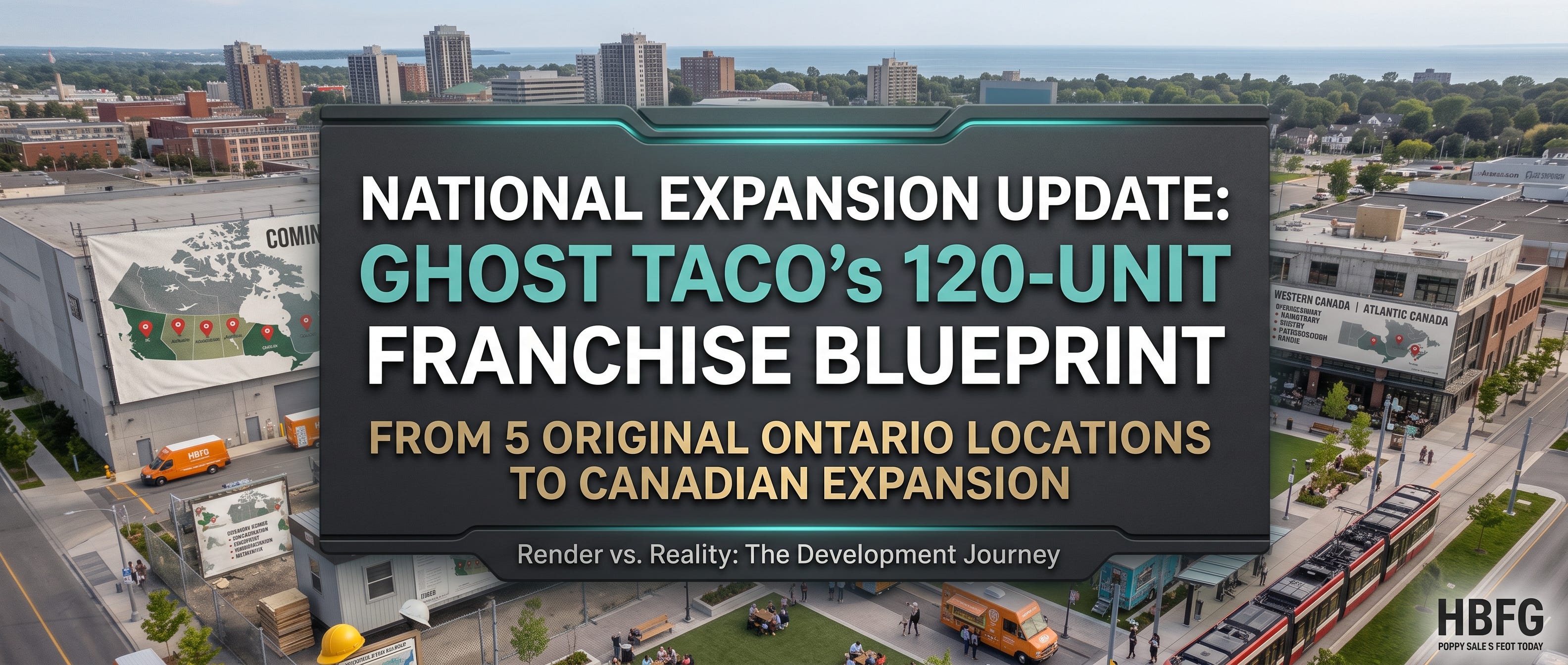
Ghost Taco had five operating restaurants when HBFG closed the transaction.
A few days later, entire regions of the country had been spoken for.
That’s what jumped out at me.
Not simply 120.
The speed.
A five-store brand entered the Happy Belly system...
and almost immediately, experienced developers wanted large pieces of the map.
Now Look at Who Took the Map
The Ontario agreement is with Scott Grandin.
Alberta and British Columbia went to Stephen Travers.
These aren’t two strangers Happy Belly found after it bought Ghost Taco.
They are already working inside the broader HBFG ecosystem.
And their history with Sean goes back much further.
Sean has described Scott as an area developer from his Mucho Burrito days who helped build the brand.
He has described Stephen as his largest Canadian area developer during that period, responsible for Alberta and British Columbia.
And according to Sean, those became Mucho Burrito’s strongest Canadian markets.
That changes the way I look at these Ghost Taco deals.
HBFG isn’t handing 95 units to two guys it met last week or from an ad seeking help on Instagram.
These are people Sean knows.
People he has built with.
People who know franchise development.
People already deploying time and capital inside Happy Belly.
And now they want Ghost Taco too.
That is a much better signal than simply “95 units signed.”
It is existing operators choosing to go deeper.
These Guys Have Already Seen a Brand Go From Small to Big
For newer investors, the Mucho Burrito history is worth understanding.
Sean Black and his partners built Extreme Brandz, the group behind Extreme Pita, Mucho Burrito and PurBlendz.
Mucho Burrito grew from a young concept into a meaningful national franchise network.
Eventually, MTY acquired Extreme Brandz.
But the more interesting part for this article isn’t what MTY paid.
It is what Extreme Brandz had already built.
By the time the transaction closed, the system had 305 restaurants.
And there was something else:
Extreme Brandz already had a U.S. operation based in:
Scottsdale, Arizona.
That office supported approximately 40 franchised restaurants in the United States and oversaw U.S. brand development.
MTY explicitly said those restaurants would represent its first stores on American territory.
That history feels particularly relevant right now.
Because thirteen years later, Sean is building another restaurant platform...
and this week Happy Belly is opening its own first U.S. HEAL.
Different company.
Different brands.
Different stage.
But there is some very familiar DNA.
The Old Network Is Showing Up in Different Ways
There is another familiar name around HEAL:
Alex Rechichi.
But Alex’s role is different from Scott and Stephen’s.
He is part of the separate franchise-development group that signed the major 45-location HEAL agreement covering Ontario, Manitoba and Saskatchewan, alongside Bedford Park Capital and the other members of that partnership.
Happy Belly’s June announcement identifies the group as being led by Alex Rechichi, David Lamph, Randall Papineau and HEAL co-founder Jesse Davidson, in partnership with Bedford Park Capital and its principals.
That group is already starting to put the agreement to work.
Kitchener has been secured.
The Laird & Eglinton location in Toronto is moving through construction.
Belleville is in the pipeline.
Again, the important part isn’t nostalgia.
It is that people connected to the previous restaurant-building network are showing up around the current one in practical ways.
Development agreements.
Territories.
Real estate.
Construction.
That is much more useful than a corporate presentation telling us the team has “experience.”
We can actually see where the experience is being applied.
Meanwhile, HEAL Just Kept Moving
Ghost Taco grabbed most of the headlines.
HEAL kept doing what HEAL has been doing.
Westmount, Quebec, was secured.
Then Kitchener.
Then HEAL signed its first franchise agreement in New Brunswick through Moncton.
Then Halifax opened.
HEAL #52 Opened in Halifax
The Bayers Lake store opened as:
HEAL #52.
The franchisee is Wade Bruce.
And Wade is another example of something I think matters.
He already operates multiple Rosie’s locations in Atlantic Canada.
Now he has added HEAL.
Happy Belly itself highlighted the significance of that in the Halifax announcement: an existing multi-brand operator choosing to invest additional time and capital within the system.
That is how a multi-brand platform should start getting stronger.
You find a good operator.
They build one concept.
They learn the system.
And if the relationship works, they take another.
One relationship starts supporting multiple brands.
That is much more efficient than having to start from zero every time HBFG adds another concept.
And Now Texas
This is probably the biggest near-term milestone.
On Saturday, October 3, HEAL opens its first U.S. location in Lubbock, Texas, directly across from Texas Tech University.
Read the official Texas opening release →
The company describes the franchisee as a well-established multi-brand, multi-unit operator in the Texas market.
And the wording in the release matters.
Happy Belly actually calls Lubbock its first U.S. “beachhead.”
That’s exactly how I would look at it.
One store by itself doesn’t change HBFG.
But one store can establish an operating base.
Now management gets to learn.
Customer behaviour.
Labour.
Suppliers.
Local marketing.
Real estate.
Unit performance.
And, most importantly, whether the existing Texas relationship can support more locations.
The company says the Lubbock operation will be used to evaluate additional U.S. growth opportunities.
So the question isn’t:
How busy is HEAL on opening Saturday?
Of course we want it busy.
The more important question is:
What does Lubbock unlock next?
Scottsdale Then. Texas Now.
This is where the Extreme Brandz history becomes interesting without forcing the comparison.
When MTY acquired Extreme Brandz, that business already had a Scottsdale, Arizona office supporting roughly 40 U.S. franchised restaurants.
MTY said that network represented its first entry into the U.S. restaurant market.
Now Sean’s current platform is beginning another U.S. chapter.
This time it starts in Texas.
I am not saying history automatically repeats.
It doesn’t.
But there is value in having already lived through the problems that come with taking restaurant brands across a border.
And this isn’t Sean trying to figure out the restaurant business for the first time.
Some of the people around him have already participated in building franchise systems at meaningful scale.
That matters.
More of the Old Pipeline Is Turning Into Something Real
There is another thing happening underneath all these headlines.
Previously announced locations are actually moving.
Laird & Eglinton: construction has started.
Yolks Vaughan: under construction, with late October being targeted by its area developer.
Richmond Hill: moving toward opening.
Rosie’s South Shore: construction progressing, with Q4 targeted.
Belleville, Collingwood and Windermere: management says they are approaching opening.
That may sound less exciting than “120 units.”
But this is the part that eventually pays.
A press release about a territory is the beginning.
A restaurant serving customers is the end of the development process.
HBFG needs both.
And right now we are increasingly seeing both happening simultaneously.
Management Says Q3 Set a New Record
Sean said Halifax represented location #18 added during Q3.
According to his count:
13 were openings.
5 came through M&A.
He described it as a new company record.
That is management’s number rather than a figure we rebuilt independently.
But it gives useful context.
The company is no longer moving one brand through one market at a time.
There are several brands at several stages of development moving simultaneously.
That is why the newsflow suddenly feels constant.
There is more machinery running.
Then the Outside World Started Paying Attention
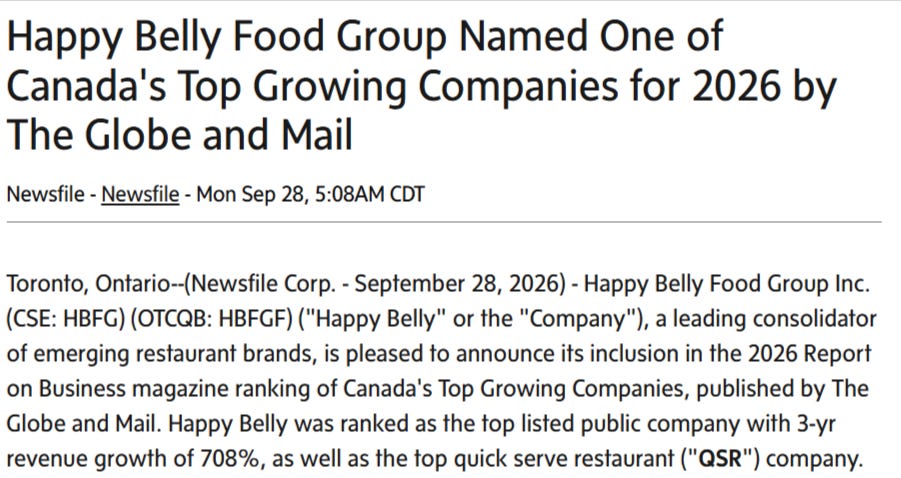
On September 28, HBFG was named to The Globe and Mail’s 2026 ranking of Canada’s Top Growing Companies.
The company reported:
708% three-year revenue growth.
It was identified in the release as the top listed public company and top QSR company in the ranking.
Read the recognition release →
Does an award make the restaurants more profitable tomorrow?
No.
But it does something else.
It puts the company in front of people who may never spend their evenings reading Canadian microcap Discord channels.
And apparently that isn’t the only broader audience HBFG reached recently.
CIBC and Wood Gundy
Sean told the TSA Discord that he was invited to present Happy Belly to the Canadian retail team at CIBC and Wood Gundy.
According to Sean:
HBFG was the only company presenting.
The event was invite-only.
HBFG did not pay to participate.
There was no financing attached.
Those are management statements, and we should treat them as such.
But the broader point is still interesting.
The company appears to be getting into rooms it probably wasn’t getting into a couple of years ago.
That isn’t the thesis.
But increasing awareness can matter when the operating business is simultaneously becoming larger.
2027 Is Starting to Become Visible
One correction from the last email.
The 30–50 new-location target is for 2027, not 2026.
Sean has also said his personal goal for 2026 was to reach $25 million in quarterly system-wide sales.
HBFG reported:
$28.4 million in Q2.
His personal stretch target for 2027 is:
$50 million per quarter.
That is not guidance.
And I’m not interested in arguing today about whether they hit exactly $50 million.
I’m interested in the ingredients.
HEAL.
Texas.
Ghost Taco.
Rosie’s.
Yolks.
More provinces.
More franchisees.
More construction.
More operating stores.
More signed pipeline.
If those continue moving, then the number becomes increasingly testable.
That is what matters.
Put the Last 15 Days Together
Ghost Taco
120 committed units across seven provinces.
HEAL
Halifax opened as #52.
United States
First HEAL opens in Lubbock on October 3.
Quebec
Westmount secured.
Ontario
Kitchener secured.
Laird & Eglinton moving through construction.
Yolks Vaughan under construction.
New Brunswick
First HEAL franchise agreement signed.
Q3
Management says 18 locations were added through openings and M&A.
Recognition
708% three-year revenue growth and inclusion among Canada’s Top Growing Companies.
That is a lot for 15 days.
But even that list misses the part I find most interesting.
The people behind the expansion.
That’s the Story I Keep Coming Back To
Scott Grandin has built with Sean before.
Stephen Travers has built with Sean before.
They helped develop Mucho Burrito during a period when the brand became a meaningful Canadian franchise business.
Today they are already involved with HBFG brands.
Then Ghost Taco enters the system.
And almost immediately:
Scott takes Ontario.
Stephen takes Alberta and British Columbia.
Meanwhile, a separate HEAL franchisee group that includes Alex Rechichi is pursuing a 45-location development agreement.
Wade Bruce is moving from Rosie’s into HEAL.
Texas is being opened by an experienced multi-brand operator.
There is a pattern there.
Good operators are not just arriving.
They are taking more.
That may be one of the most important signals in HBFG right now.
Because brands are only part of the equation.
You still need people capable of turning a signed agreement into functioning restaurants.
And HBFG increasingly has operators choosing to deploy more of their own time and capital inside the system.
What Matters Next
For me, the next stage is pretty straightforward.
Ghost Taco: turn the 120 committed units into franchisees, sites, construction and openings.
Texas: establish that HEAL can work outside Canada and see what the operating base unlocks.
HEAL: continue converting the large signed pipeline.
Rosie’s and Yolks: keep progressing through construction.
2027: make enough of the growth visible in advance that investors can increasingly see what is coming instead of simply being told.
And underneath all of that:
Keep the best operators wanting more.
That may be the most important one.
The Bottom Line
If you’ve been following HBFG with us, you already know what Sean says he wants to build.
The interesting part now is watching whether it repeats.
HEAL gave us the first real proof.
Rosie’s added more evidence.
Now Ghost Taco gives us a fresh test almost from day one.
Five operating restaurants.
HBFG closes the deal.
Then:
45 Ontario.
50 in Alberta and BC.
25 in Atlantic Canada.
120 committed units.
But the number is only half the story.
Look at the people behind it.
Operators who have built with Sean before.
Operators already putting capital behind other Happy Belly brands.
People who have already lived through the process of taking restaurant concepts from early stage to much larger franchise networks.
And now they’re building again.
At the same time, HEAL is opening Halifax, entering New Brunswick, and crossing into the United States.
The last platform Sean helped build eventually opened the U.S. door for MTY through its Scottsdale operation.
Now Happy Belly is beginning its own American chapter in Texas.
Different company.
Different brands.
Different time.
But some very familiar people and a very familiar playbook.
The thesis hasn’t changed.
What’s changing is how much evidence is starting to sit behind it.
And over the last 15 days, a lot of that evidence showed up at once.
Talk soon,
The Stock Avengers
Independent research and opinion only. This is not investment advice. The Stock Avengers receives no compensation from Happy Belly Food Group or any issuer covered in this publication. TSA and/or its contributors may own shares of HBFG. Management statements are identified as such and should be independently verified. Readers should conduct their own due diligence.