Far fewer know about the restaurant group, the people and the local relationships behind the expansion of HEAL Wellness and Rosie’s Burgers into Texas.
Thanks for reading! Subscribe for free to receive new posts and support my work.
The partner’s name did not appear in the original news release. Happy Belly described an “experienced multi-unit franchise operator” with “strong local market knowledge,” but shareholders were not told who the operator was or what experience stood behind the agreement.
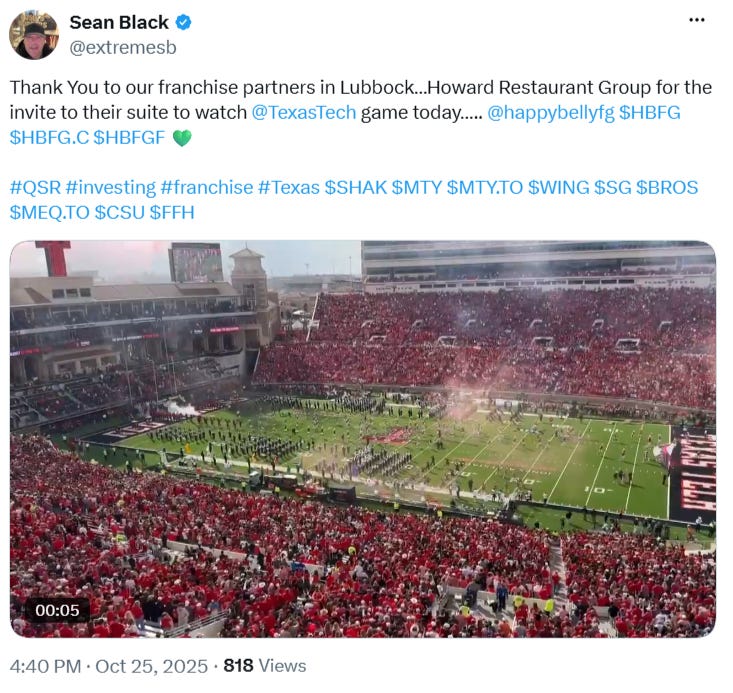
Then, on October 25, 2025, CEO Sean Black provided the missing name.
While attending a Texas Tech football game in Lubbock, Black publicly thanked his hosts:
“Our franchise partners in Lubbock… Howard Restaurant Group.”
The pieces were public. They simply had not been put together.
Howard Restaurant Group is not simply an operator willing to open a franchise. It is connected to decades of restaurant ownership, multi-unit development and local business relationships across West Texas.
That appears to be exactly the kind of partner Happy Belly wanted for its first move into the United States.
The operator behind the agreement
Happy Belly formally announced its Texas expansion on June 5, 2025.
HEAL Wellness had signed a 10 unit development agreement with a U.S.-based QSR developer for the Greater Dallas–Fort Worth market. Sean Black emphasized the importance of putting “boots on the ground” and choosing the right local partner as Happy Belly established itself in the United States.
By November, the group had secured HEAL’s first U.S. real estate near Texas Tech University. Days later, Rosie’s Burgers was added to the same property through the same franchise relationship.
Happy Belly confirmed that its Texas partners were becoming “multi-branded operators within the Happy Belly portfolio.”
That wording deserves attention. Happy Belly had not merely found someone prepared to open a HEAL franchise. It had found an organization willing to introduce multiple Happy Belly concepts into the U.S. market.
The same operator could apply its local knowledge, restaurant experience and development relationships to more than one brand. That is where the Texas story becomes much more interesting than a conventional franchise agreement.
Meet Kendall Howard
There are restaurant franchisees, and then there are people who have spent decades building restaurant systems across multiple territories.
Kendall Howard falls into the second category.
In 2012, when Howard opened a Mama Fu’s Asian House in Lubbock, QSR Magazine described him as a 16-year restaurant-franchise veteran. By that point, he was already a franchisee of 19 Buffalo Wild Wings locations across West Texas, Oklahoma and Arkansas.
He also owned Las Brisas Steakhouse in Lubbock and served on the boards of the Lubbock Restaurant Association, Lake Ridge and University Medical Center. His community involvement extended to organizations including the Children’s Miracle Network, United Way and St. Jude Children’s Research Hospital.
Howard entered Mama Fu’s through an 11-unit development agreement covering Northwest Texas and San Antonio. That requires a different skill set from operating a single successful restaurant.
Territorial development means building a pipeline of locations, coordinating openings, establishing management depth and creating processes that can be repeated across markets. It means thinking beyond one store.
In 2018, Howard entered another multi-unit development arrangement. Lashford Howard LLC—owned by Kendall Howard together with Patrick and Tara Lashford—signed an agreement to develop 11 Newk’s Eatery restaurants across West Texas and Greater San Antonio.
The planned territory included Lubbock, Amarillo, Abilene, Midland, Odessa, San Angelo, El Paso and the San Antonio market.
The pattern is clear: Buffalo Wild Wings, Mama Fu’s, Newk’s Eatery and now HEAL Wellness and Rosie’s Burgers.
Different concepts and different formats, but the common denominator is an operator accustomed to developing restaurant brands across multiple markets.
That is precisely the type of experience Happy Belly can benefit from as it moves beyond Canada.
An active West Texas restaurant organization
Howard’s restaurant history is extensive, but this is not simply a story about accomplishments from a decade ago.
Howard Restaurant Group continues to appear in Texas restaurant-development and construction records, reflecting an organization that remains connected to the physical work of operating, maintaining and developing restaurants.
The Lubbock Chamber of Commerce also continues to list Howard Restaurant Group as part of the local restaurant business community.
Howard’s broader business network makes the partnership even more compelling.
Together with Howard Restaurant Group’s multi-unit operating history, territorial-development experience, real-estate relationships and local connections, this creates an unusually complete development ecosystem.
Happy Belly is not entering Texas with a franchisee that must build its local infrastructure from scratch. It appears to have a partner capable of helping move its brands from site selection and construction through to opening and restaurant operations.
For a Canadian company entering the United States, that ongoing presence is significant. Howard Restaurant Group already understands the market, has local relationships and knows what it takes to operate restaurants in West Texas.
Happy Belly does not need to manufacture that experience from scratch.
Paul Fioroni and the local network
If Kendall Howard represents the restaurant-development side of the partnership, Paul Fioroni helps illustrate the depth of the local Lubbock network surrounding it.
Fioroni has been embedded in the community for decades. He played professionally for the Lubbock Cotton Kings before becoming head coach of the Texas Tech Hockey Club.
When Texas Tech announced his appointment in 2006, Fioroni made it clear that his mission extended beyond the ice. He wanted to build corporate and community partnerships throughout Lubbock.
His own words captured the approach:
“A successful team requires successful community and corporate partnerships.”
Fioroni’s relationship with Kendall Howard also predates Happy Belly’s expansion. When Howard announced the Newk’s territorial-development agreement, Fioroni publicly congratulated him.
More recently, Fioroni has appeared in activity surrounding the HEAL project near Texas Tech. The significance is not a particular title; it is the depth and history of the relationships around the expansion.
Before most shareholders knew Howard Restaurant Group was behind the project, Sean Black was already watching Texas Tech football from the group’s suite.
The phrase “strong local market knowledge” suddenly carries much more weight.
Two Lubbock locations and the Texas Tech opportunity
Happy Belly now has two identifiable HEAL locations moving forward in Lubbock.
The first is positioned near Texas Tech University and will introduce both HEAL Wellness and Rosie’s Burgers through a shared property. The second is a standalone HEAL location in another part of the city.
These are not two identical restaurants placed in similar environments.
The Texas Tech location gives Happy Belly access to a large and growing university community while introducing two portfolio brands together in the United States. The standalone location presents HEAL in a more compact format within a different Lubbock retail environment.
Together, the sites give the local operator an opportunity to establish the brand across distinct customer bases while applying the same market knowledge and operating relationships.
The university setting is increasingly compelling. Texas Tech reported a record enrollment of 45,812 students for fall 2026—an increase of more than 3,800 students in one year and growth of more than 12% over two years.
HEAL’s smoothies, açaí bowls and wellness-focused menu appear well suited to students and young professionals looking for convenient food options. Rosie’s offers a complementary concept built around smash burgers, fries, poutine and milkshakes.
One is health-focused. The other is indulgent.
Together, they broaden the appeal of a highly visible university-area property while introducing two Happy Belly concepts to the U.S. market at once.
The local execution layer
Another name appearing around both HEAL projects is Zac Howell.
Howell is a senior associate at Fairway Commercial Advisors, a commercial real-estate brokerage based in Lubbock. His involvement across both properties provides another indication that the expansion is moving through a consistent local network.
That is what “boots on the ground” looks like in practice: Howard Restaurant Group’s restaurant experience, Fioroni’s longstanding community relationships, Howell’s role within the local real-estate process and a repeat project team supporting multiple sites.
Happy Belly has not entered Lubbock as an unfamiliar Canadian company searching for its first local contact. It appears to have entered through an established restaurant organization surrounded by people who understand the city, its real estate and its business community.
That is an important distinction.
From a portfolio to a platform
The decision to add Rosie’s Burgers to the Texas Tech property may be the clearest early demonstration of Happy Belly’s portfolio strategy.
The location was larger than HEAL required. Rather than allowing that additional space to become a disadvantage, Happy Belly used it to introduce another brand through the same franchise partner.
The company turned one real-estate opportunity into a launchpad for two concepts.
That is the difference between owning a portfolio and building a platform. A platform creates infrastructure and relationships that can be reused across brands.
Happy Belly did not need to find a second Texas operator for Rosie’s or establish an entirely separate local network. The same restaurant organization, market knowledge and development relationships could support both concepts.
The next Happy Belly brand entering the market may not have to begin from zero.
One capable operator can potentially become a distribution channel for multiple concepts. One successful market entry can build familiarity with the broader portfolio. One established local network can support more than one opening.
Howard Restaurant Group is particularly compelling in this context because developing multiple restaurant concepts is already part of its history.
This is familiar territory.
What most shareholders missed
Almost nothing in this story was truly hidden.
Sean Black named Howard Restaurant Group publicly. Kendall Howard’s restaurant résumé was public. His Buffalo Wild Wings, Mama Fu’s and Newk’s history was public. Paul Fioroni’s Texas Tech background was public. The Lubbock locations, the local execution and the decision to give Rosie’s to the same franchise group were public.
Each piece appeared ordinary on its own.
Put them together and a much more important picture emerges.
Happy Belly has not merely found someone willing to open HEAL in Texas. It appears to have connected two of its brands to an established West Texas restaurant organization with decades of multi-unit experience, deep local relationships and an active development network in Lubbock.
The obvious story is that Happy Belly is entering the United States.
The more important story is how.
Through Howard Restaurant Group, Happy Belly appears to have secured something that is difficult to build quickly: an experienced local restaurant ecosystem and a potential distribution channel for multiple concepts.
Most shareholders already knew the company was heading south. They knew about the 10-store agreement, HEAL and Rosie’s.
What many may not have appreciated was the experience and local network behind the expansion.
Now the name has a history.
The history has people.
The people have relationships.
And those relationships are already carrying multiple Happy Belly brands into Texas.
Howard Restaurant Group was hiding in plain sight.
Once you understand what sits behind the name, Happy Belly’s Texas expansion looks considerably bigger—and considerably more bullish—than the original announcement suggested.
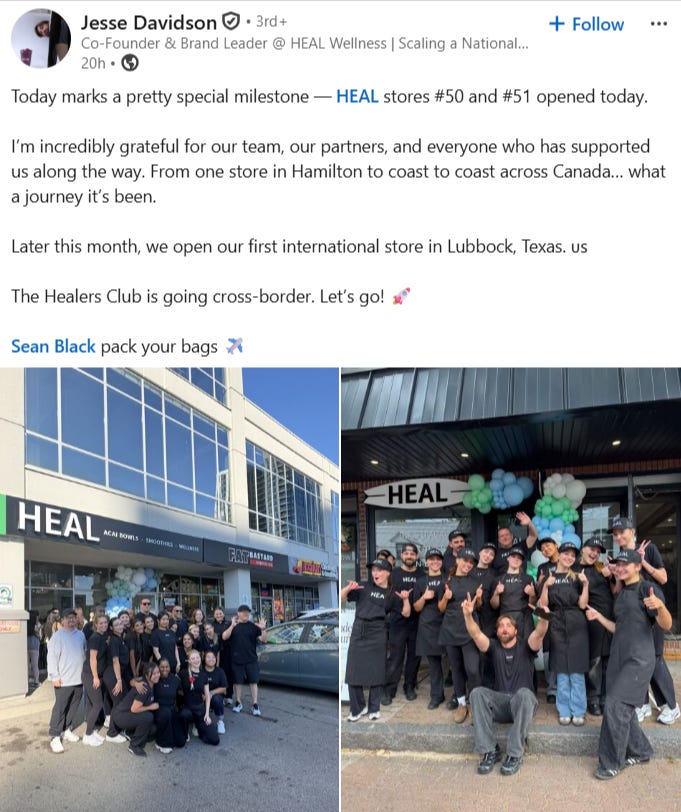
Unrelated to the US news but a major HEAL milestone, Congrats on 50 & 51!
Disclosure: The authors Veritas & MoneyMaker are supporters of Happy Belly Food Group and may own shares. This article reflects personal research and opinion and is not financial advice.
Thanks for reading! Subscribe for free to receive new posts and support my work.