

EMERGE Commerce still has a financing problem. But once you rebuild the liquidity, dilution, cash flow and debt structure properly, the investor takeaway changes.
A recent review of EMERGE Commerce got a surprising amount right.
The balance sheet is still weak.
Liquidity remains constrained.
Dilution is real.
The convertible matters.
The senior credit facility matters.
And despite a much better operating quarter, EMERGE has not finished repairing its capital structure.
All true.
The problem is that several of the conclusions built on top of those observations are either too aggressive, insufficiently normalized, or incomplete.
And in this case, the details matter because they change what investors should actually be watching.
What the unnamed reviewer got right
Start with the operating business.
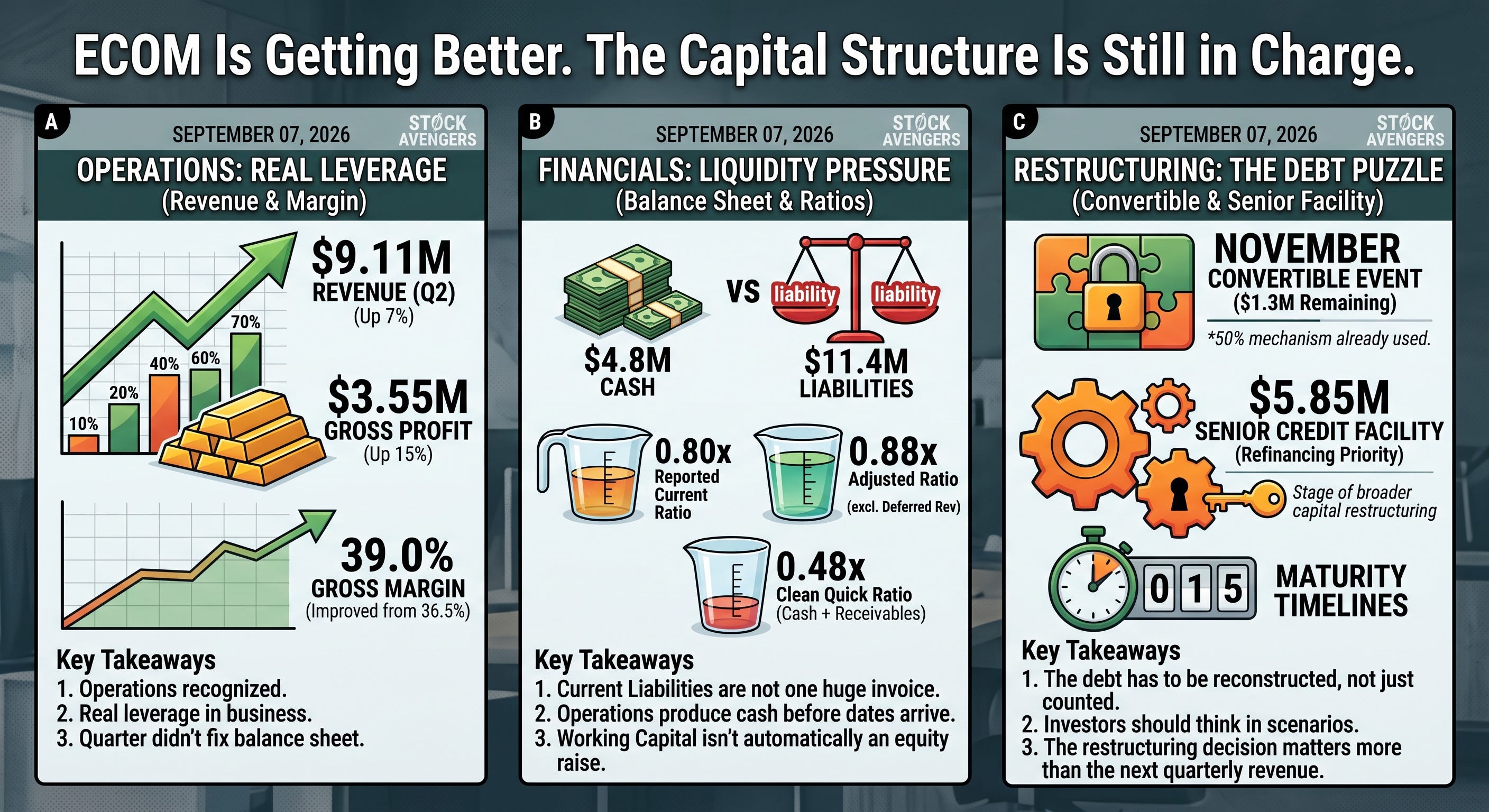
Q2 revenue increased from $8.48 million to $9.11 million, up about 7%.
Gross profit increased almost 15% to $3.55 million.
Gross margin improved from 36.5% to 39.0%.
And operating income before the below the line items increased from roughly $524,000 to $883,000.
That is real operating leverage.
The review correctly recognized it.
It also correctly refused to treat the better quarter as proof that the balance sheet was suddenly fixed.
At June 30, EMERGE had about $4.8 million in cash, $9.1 million in current assets and $11.4 million in current liabilities.
So yes, capital structure first.
That was the right instinct.
But the liquidity numbers need labels
One of the review’s headline liquidity numbers was a current ratio of roughly 0.88x.
The reported current ratio is actually:
$9.109M current assets / $11.413M current liabilities = about 0.80x.
So where does 0.88x come from?
By removing approximately $1.08 million of deferred revenue from current liabilities.
And that is not necessarily crazy.
Deferred revenue is economically different from a conventional payable because satisfying it does not usually require writing a cheque for the full liability.
So an analyst can reasonably show an adjusted operating liquidity ratio excluding deferred revenue.
But then call it that.
The cleaner presentation is:
Reported current ratio: 0.80x
Adjusted ratio excluding deferred revenue: 0.88x
Both are useful.
They just answer slightly different questions.
The same issue appears in the approximately 0.59 quick ratio.
That number can also be reconstructed.
It appears to exclude inventory while keeping prepaid expenses in the numerator and deferred revenue out of the denominator.
The arithmetic works.
The label is the problem.
Prepaids are generally not quick assets. They cannot normally be used to pay creditors.
Using only cash and receivables gives quick liquidity closer to 0.48x on reported liabilities, or roughly 0.53x using the deferred revenue adjusted liability base. EMERGE’s liquidity is therefore arguably weaker than the headline quick ratio suggests.
This is not some devastating error.
But it matters when those ratios are subsequently used to argue how much financing the company supposedly needs.
A working capital hole is not automatically an equity raise
This is where the interpretation becomes more important than the ratios.
The review effectively identifies a multimillion dollar gap between selected liquid assets and adjusted current liabilities.
That proves something.
It proves EMERGE has liquidity pressure.
It does not prove that the same amount must be raised through equity.
Current liabilities are not one giant invoice due tomorrow morning.
Accounts payable turn over.
Inventory sells.
Deferred revenue becomes revenue.
Receivables are collected.
New sales generate new liabilities and new cash.
Meanwhile, EMERGE generated approximately $1.21 million of operating cash flow during the first six months of 2026.
So the right question is not:
How large is the accounting deficiency?
It is:
How much cash must actually leave the business, on what dates, and how much can operations produce before those dates arrive?
That is a very different calculation.
And it leads directly to the most important part of the story.
The debt has to be reconstructed, not just counted
The review correctly identifies the remaining convertible debt as important.
But knowing the balance is not enough.
You have to understand how it got there.
The debentures were materially amended in 2024.
The amendment extended maturity, changed conversion economics and created a special mechanism allowing EMERGE to deal with up to 50% of the principal.
EMERGE used it.
Roughly half of the original principal was already eliminated through share issuance.
That means the remaining convertible today is the residual portion after the 50% allocation was consumed.
That distinction is critical.
The company cannot simply repeat the exact same solution under the existing terms.
So November is a real event.
But it is not simply:
$1.3 million comes due, therefore equity raise.
The possibilities include cash repayment, voluntary conversion, another negotiated amendment, refinancing or some combination.
And that becomes even more important once you look at the second major piece of debt.
The convertible is sitting in front of a $5.85 million refinancing
EMERGE’s senior credit facility has approximately $5.85 million outstanding.
In March 2026, management amended the facility again and extended maturity to October 2027.
The interest rate remains expensive, and management explicitly says refinancing the senior debt is one of its key priorities.
That raises a question the review should have pushed harder:
Are the convertible and senior facility actually two separate problems?
Maybe.
But they may also be two stages of the same broader capital restructuring.
If management is already looking for a replacement or improved senior financing package, it is entirely reasonable to consider whether the convertible gets dealt with as part of that process.
That does not mean it will.
It means investors should think in scenarios rather than treating one financing outcome as inevitable.
The cash flow argument also needs a bridge
The review’s instinct that reported operating cash flow may overstate clean underlying cash generation is fair.
EMERGE has unusual working capital dynamics, including the Tee 2 Green inventory payment plan.
That arrangement gives the company a cash flow advantage because inventory can be sold long before the related vendor obligation is fully paid.
That is real economic value.
But it also means reported CFO should not automatically be treated as completely unencumbered recurring free cash.
Fair point.
The problem comes when a normalized cash flow conclusion is stated without showing the actual normalization.
If reported CFO is being adjusted downward because of vendor financing or working capital timing, show:
Reported CFO
less financing-assisted working-capital benefit
plus/minus temporary working-capital effects
= normalized CFO
Without that bridge, the direction may be right while the magnitude remains difficult to reproduce.
That matters when the normalized number is then used to forecast another financing.
The dilution criticism is right — but incomplete
The review was absolutely right to highlight dilution.
The March financing issued 27 million shares, plus 13.5 million $0.15 warrants and 773,000 broker warrants.
Weighted average shares increased from about 142.3 million to 176.5 million year over year.
That is significant.
But “share count went up” is only half the analysis.
The financing primarily funded the acquisition of Viral Loops and provided additional corporate liquidity.
So the real question is:
What did shareholders receive for giving up that ownership?
We do not yet have enough evidence to declare the dilution productive or destructive.
But we can say something uncomfortable already.
Q2 revenue increased about 7%.
Gross profit increased about 15%.
Weighted average shares increased about 24%.
So the company improved faster than before.
But the ownership denominator improved faster still.
That means consolidated growth has not yet translated into equivalent per share growth.
That is the stronger dilution argument.
The Viral Loops criticism goes too far
The review also takes issue with the March financing being described as acquisition related because EMERGE raised approximately $2.7 million gross while Viral Loops required about $2.1 million at closing.
That criticism is fair up to a point.
The raise did exceed the immediate closing cheque.
But the filing says proceeds were used for Viral Loops and general corporate purposes, and Viral Loops also included another $200,000 payable later.
There were also financing fees, transaction costs, integration expenses and ordinary working-capital requirements.
So the interesting question is not whether management committed some semantic crime by raising more than the closing cheque.
The interesting question is:
Was the extra dilution economically worth it?
That will be answered by what Viral Loops produces.
Not by rhetoric around the financing announcement.
Organic growth is another place where precision matters
The filing says EMERGE achieved positive overall organic growth in Q2.
It also says consolidated growth benefited from Tee 2 Green and Viral Loops.
That supports the conclusion that some of the growth was organic and some acquired.
What it does not necessarily support is an exact split unless the acquisition contribution can be reconstructed from disclosed numbers.
There is nothing wrong with estimating.
Just call it an estimate.
“Approximately half organic and half acquired” sounds factual.
If the filings do not provide the bridge, it is inference.
Small distinction.
Important habit.
Where the review was strongest
None of this should obscure what the review did very well.
It identified what matters first.
That is harder than it sounds.
A weaker review could easily spend 2,000 words congratulating EMERGE on margin expansion while barely mentioning the instruments that may determine what existing shareholders own a year from now.
The familiar review did not make that mistake.
Liquidity.
Convertible.
Senior refinancing.
Dilution.
Those are the right subjects.
And that is why the corrections matter.
When you identify the correct pressure point, you owe the reader an equally careful explanation of the mechanism.
So what really matters now?
Three things.
1. How the remaining convertible is resolved
The old 50% mechanism has already been used.
So the next resolution matters.
Cash?
Shares?
Another amendment?
A broader refinancing?
The terms will tell us more than anybody’s prediction beforehand.
2. What happens to the $5.85 million senior facility
Management is already pursuing refinancing.
That could be enormously important.
A lower borrowing cost would allow more of the company’s operating improvement to reach shareholders.
A poor refinancing could simply extend the problem at an expensive price.
3. Whether the business finally outruns the share count
The operating numbers are improving.
Now per share economics have to follow.
Revenue per share.
Gross profit per share.
Normalized earnings per share.
Free cash flow per share.
That is the scoreboard.
The Bottom Line
The familiar review got more right than wrong.
That is not faint praise.
It correctly identified the improving operating business and correctly refused to ignore the weak capital structure sitting on top of it.
But several important conclusions became less rigorous once the review moved from identifying the problem to explaining exactly how it would be resolved.
The liquidity ratios were adjusted in ways that should have been labeled more clearly.
The quick ratio treated prepaids too generously.
The working capital shortfall was pushed too directly toward a financing prediction.
The cash flow normalization was not fully shown.
The 50% convertible mechanism had already been used.
The convertible and senior facility may belong in the same broader restructuring analysis.
And dilution was identified correctly without fully asking whether the assets purchased with that dilution ultimately create enough value per share.
That leaves us with a much simpler EMERGE thesis.
The business is improving.
The capital structure is not fixed.
The next restructuring decision matters more than the next quarterly revenue number.
And the most important question is no longer whether EMERGE can grow.
It is whether management can finish cleaning up the balance sheet without giving away too much of that growth before existing shareholders finally get to keep it.