

Bullish thesis: I went back through years of Happy Belly commentary to test whether the historical record supported the confidence I already had in management. What stood out was not perfection. It was consistency between what management said, how it aligned itself with shareholders, and what the business ultimately delivered.
There are dozens of ways to analyze a small cap company.
Revenue growth. EBITDA. Cash flow. Dilution. Unit economics. Same store sales. Acquisitions. Valuation.
But in Canadian microcaps, there is another variable that deserves more weight than investors often give it:
Can you trust management to do what they say they are going to do?
That sounds simple.
It is not.
Small cap investors are constantly sold the future. There is always another acquisition coming, another market opportunity, another transformational quarter, another presentation showing what the company could become.
The problem is that aspirations are cheap.
Execution is not.
That is why I wanted to look at Happy Belly Food Group differently.
Rather than starting with one quarter, one accounting adjustment, or one current concern, I went back through years of management commentary and asked a broader question:
Has the long term record actually supported what management has been telling shareholders?
Not whether every quarter was perfect.
Not whether every target landed exactly on schedule.
Not whether every acquisition worked flawlessly.
And certainly not whether you can find an individual line item in a financial statement worth questioning.
You always can.
The more important question is:
Over several years, have management’s actions remained congruent with its words, incentives and stated objectives?
After going through the history, I think the answer is clearly yes.
And that is important because management credibility is not established in a conference call.
It is established over years.
One Quarter at a Time
If there is one phrase that captures the early HBFG story, it is probably this one:
One quarter at a time.
Sean Black used variations of it repeatedly through 2023 and beyond.
In May 2023:
“Just be patient and watch us grow this thing one Q at a time.”
A month later:
“Just watch for Q2 FINS…one Q at a time.”
And later that year:
“No skipping bases we are working to build a real business.”
At the time, those were just words.
What matters is what followed.
The company began putting together a sequence of reported record quarters.
November 2022 marked its second consecutive record quarter.
April 2023 marked its third.
May brought the fourth.
August brought the fifth.
November brought the sixth.
The streak continued through 2024 and into 2025.
Eventually, what had sounded like an early stage CEO asking shareholders for patience became a measurable operating pattern.
That distinction matters.
Anyone can ask investors for time.
The credibility comes from what the business looks like after that time has passed.
With HBFG, each successive period increasingly left behind a larger operating platform than the one before it.
That does not prove the stock is cheap.
It does tell us that the operating direction management described was real.
Alignment Was Built Into Phase 1
One of the strongest parts of the HBFG story has been management’s emphasis on shareholder alignment.
And unlike a lot of microcap language around “skin in the game,” this was not merely rhetorical.
The original structure was built around performance warrants.
Management did not simply give itself a large block of free shares at distressed prices.
It invested capital.
It purchased shares.
And much of the meaningful upside had to be earned through predetermined share price thresholds.
Sean summarized the philosophy in November 2023:
“The reason we took ZERO FREE OPTIONS was to align ourselves with our retail shareholders…we only make real $$ when they do.”
That original incentive structure was effectively Phase 1.
The objective was ambitious at the time.
Management had performance warrants extending all the way to $2 per share, with tranches unlocking only as the share price progressed.
Sean repeatedly discussed those warrants publicly.
At $0.50, another tranche became relevant.
Later came $1.50.
Then $2.
And importantly, earning those warrants did not mean receiving free stock.
Management still had to write cheques into the company treasury to exercise them.
That distinction is fundamental.
The better the company performed, the more management earned the right to invest additional personal capital into the company.
If shareholders did not win, management did not receive the full economic benefit.
If management succeeded, the exercise of those warrants also brought additional capital into HBFG.
By early 2026, Sean described the original plan as a self funding mechanism that had been put in place years earlier.
That is exactly what eventually happened.
The Phase 1 warrants were exercised.
Millions of dollars flowed into treasury.
Insider ownership increased.
And the first major incentive cycle effectively reached completion.
That is a very different outcome from the typical microcap story where insiders receive cheap paper, sell it into liquidity, and then ask shareholders to finance the next chapter.
Phase 2 Resets the Alignment Higher
This is where the story becomes even more interesting.
Management did not reach the original objective and then abandon the incentive structure.
It effectively moved the alignment higher.
By late 2025, Sean was discussing warrants and options extending from approximately $2 to $10.
Then in February 2026, he described another block of performance warrants this way:
“1,000,000 Performance Warrants….at $2….they unlock from $3-$10.”
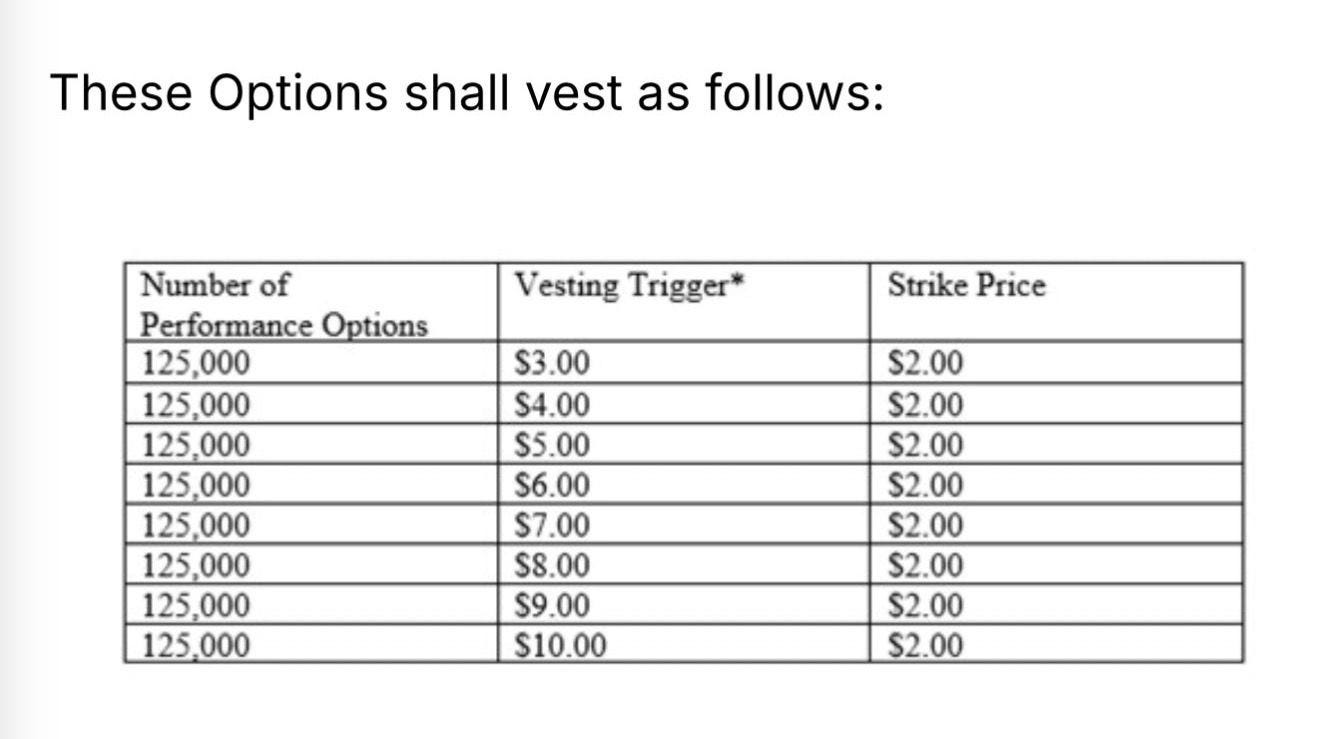
That is the beginning of what I view as Phase 2.
The first incentive structure was built around transforming a distressed microcap into a credible operating company and moving toward the original $2 objective.
The next incentive structure is tied to what happens after that.
$3.
$4.
$5.
And ultimately much higher levels if the company continues creating value.
That matters because it tells us something important about management’s incentives after Phase 1.
They are not simply aligned with preserving what has already been built.
They remain economically incentivized to build the next stage.
The target moved higher because the company moved higher.
That is exactly how I would want a long term incentive structure to evolve.
Phase 1 asked:
Can this team rescue the company, build a real operating platform and create substantial shareholder value?
The answer so far has been yes.
Phase 2 asks a much harder question:
Can the same team take a 100 location Canadian platform and build it into something materially larger?
That remains to be proven.
But once again, management’s economic incentives are tied directly to shareholders benefiting if they succeed.
Why This Matters More Than It Appears
This is also why I think investors can lose perspective when they become overly focused on individual accounting debates.
Questions around share based compensation matter.
Questions around salaries matter.
Questions around adjusted EBITDA matter.
Questions around dilution matter.
They should be analyzed.
But they should also be weighted properly.
There is a difference between identifying a legitimate accounting concern and allowing that concern to overwhelm four years of evidence regarding management behavior.
When I look at HBFG, I see a management team that established performance based incentives when the company was barely relevant.
I see those original incentives becoming valuable only after shareholders experienced substantial appreciation.
I see insiders then putting additional personal capital into the company to exercise them.
I see treasury being strengthened rather than drained.
And now I see the next compensation structure tied to substantially higher share price levels.
That does not make every criticism wrong.
It does make the larger alignment question much harder to dismiss.
The important point is not that management should never be questioned.
It should.
The important point is that investors should not mistake constant criticism for superior analysis.
Sometimes the most important conclusion comes from stepping back far enough to recognize the pattern.
And the pattern here is difficult to ignore:
Phase 1 alignment worked.
Management had to create shareholder value to earn its economics.
The company grew.
The share price moved.
The warrants were earned and exercised.
Capital flowed back into treasury.
And now Phase 2 begins with management once again incentivized at materially higher levels.
That is not noise.
That is structure.
And in my view, it deserves considerably more weight when judging management than an isolated accounting argument from a single quarter.
Join 3,000+ Canadian retail investors in the Stock Avengers Discord.
Continue the conversation, ask follow-up questions, dig deeper into the companies we cover, and see ongoing research, community DD, trade discussion, and analysis of other Canadian stocks.
The article is the research. The Discord is where the discussion continues.